
Comprehensive test management solution for complex challenges.

Remote Testing: Benefits, Challenges, and Best Practices for Distributed QA Teams
Irina Maiber-Teichert
in
#Remote Testing
#Software Testing
#Quality Assurance
#Test Management
#Test Automation
#Distributed Teams
·
12.10.2026
·
10 min. reading time
Remote testing is more than software testing from home. Learn how clear processes, responsibilities, and best practices help distributed QA teams succeed.
Remote testing enables companies to bring in testing expertise regardless of location and adjust testing capacity to actual demand. But successful distributed quality assurance requires more than virtual meetings and access to a test environment.
What matters is not where a testing team works, but how well the underlying QA processes work. Once spontaneous in-person coordination is no longer possible, responsibilities must be clearly defined, information must be documented in a traceable way, and testing processes must function without depending on individual team members.
At the same time, many software projects face growing demands for quality, release speed, and flexibility. Development, quality assurance, and business teams often work across multiple locations. Specialized expertise is not always available where it is needed. And before releases, migrations, or go-lives, testing demand can increase significantly.
When organized effectively, remote testing is therefore much more than software testing from home. It is an operating model that allows companies to scale quality assurance and integrate the expertise they need into existing teams.
What Is Remote Testing?
Remote testing refers to the planning, execution, and management of software testing activities by geographically distributed teams. Everyone involved can access relevant requirements, test cases, test environments, and test results regardless of location.
Remote testing is therefore not a testing method in itself. Functional testing, regression testing, performance testing, and automated testing do not fundamentally change just because a team is distributed. What does change are the requirements for organization, communication, documentation, and technical access.
Remote Testing Is More Than Software Testing From Home
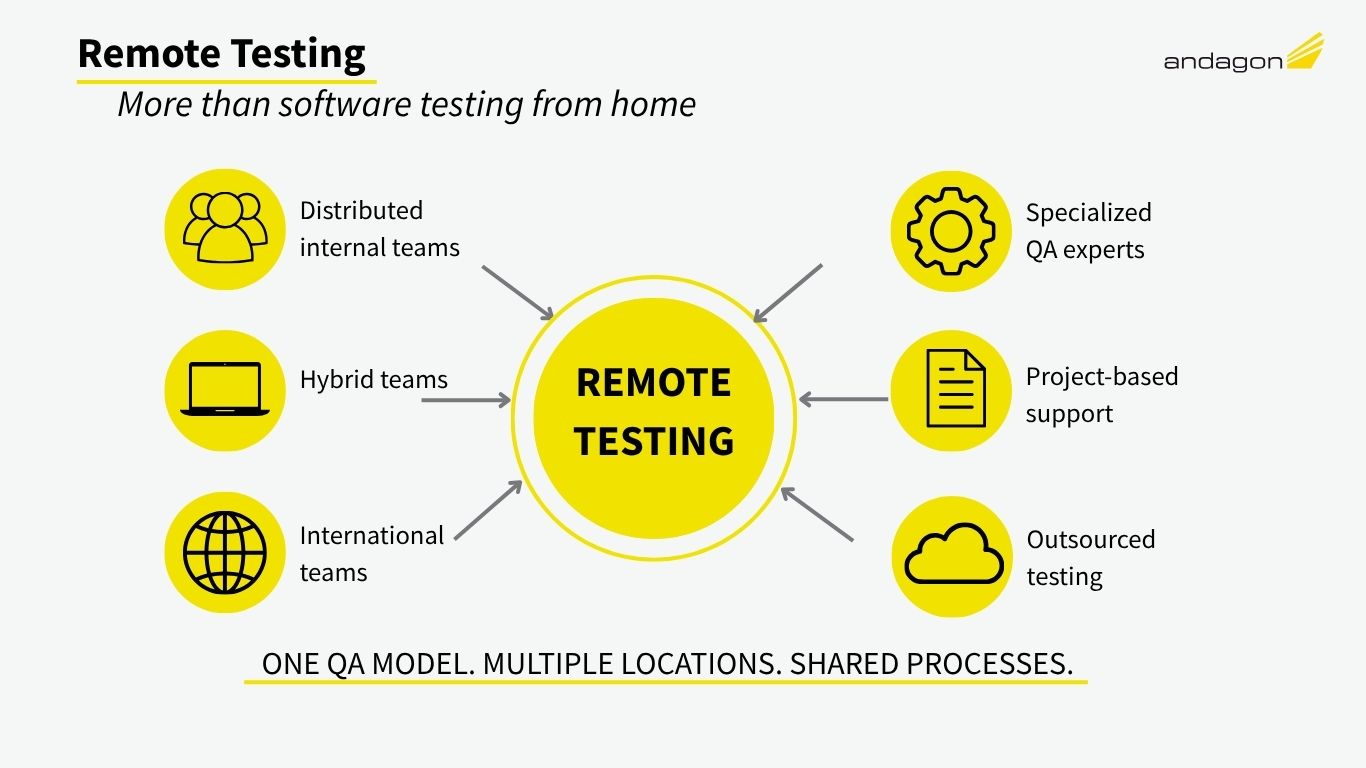
Someone who occasionally accesses a test environment from home is not automatically working within a distributed QA model. Remote testing becomes relevant when testing activities are coordinated across different locations on an ongoing or project-specific basis.
In practice, we encounter different models:
- distributed internal testing teams
- hybrid teams of internal and external specialists
- international development and testing teams
- collaboration with specialized testing service providers
- project-specific support for releases or migrations
- fully outsourced testing services
The right model depends less on location than on the expertise required, available internal capacity, and how quality assurance is organized.
Why Remote Testing Is Becoming More Important for Software Projects
We're seeing the same trend among many of our customers: Shorter release cycles, distributed development, limited access to QA specialists, and increasingly complex software environments are driving the need for more flexible testing structures. At the same time, specialized QA professionals with expertise in test management, test automation, or specific testing methods are not available internally or locally for every project.
Agile development, DevOps, and continuous delivery also shorten the time between releases. Testing needs to begin earlier, be more closely integrated with development, and provide reliable results within shorter cycles.
Another factor is the technical complexity of modern software environments. Web applications, mobile apps, cloud services, SAP systems, and external services need to be tested both individually and as part of the overall system. This diversity requires specialized testing expertise in certain areas that goes beyond the general testing capabilities of the team.
However, the required experts are not always available internally or at the respective project location. When they need to be brought into testing at short notice, remote testing makes it possible to add the required expertise regardless of location.
Remote testing does not solve these challenges automatically. However, it provides the organizational foundation for bringing in the required expertise and additional testing capacity regardless of the project location.
What Are the Benefits of Remote Testing?
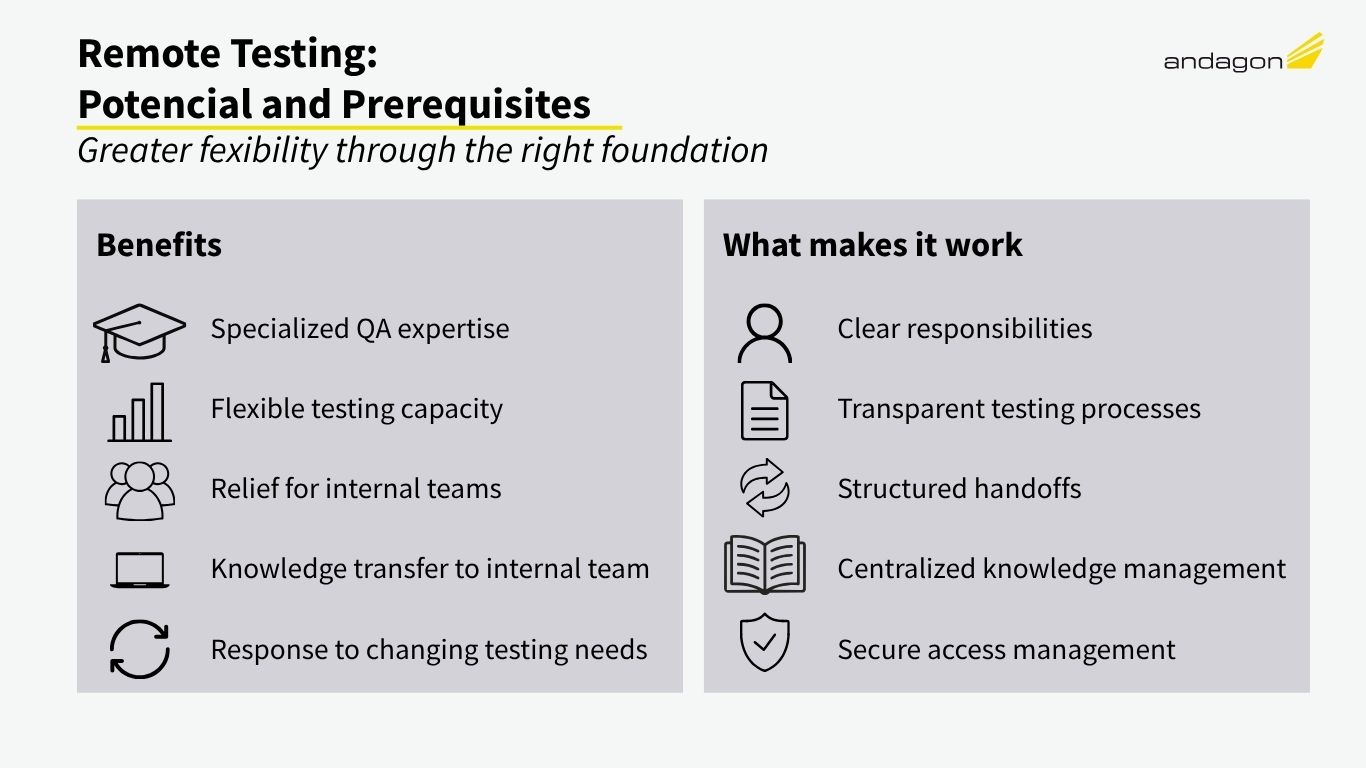
Remote testing makes it possible to deploy the required QA expertise and capacity regardless of the project location. In our client projects, five benefits in particular stand out.
1. Access to Specialized QA Expertise
Not every testing competency needs to be permanently available internally or at the respective project location. Remote testing makes it easier to bring in specialists for specific projects, for example in test automation, performance testing, SAP testing, accessibility testing, security testing, or test management. This allows companies to add specialized expertise where it is needed for a specific system, project, or quality risk.
2. Scale Testing Capacity Flexibly
Testing demand often increases significantly before releases, migrations, or go-lives. Maintaining an internal QA organization permanently sized for these peak workloads does not make sense in every situation.
Remote testing makes it possible to add testing resources specifically for a particular project phase and flexibly adjust testing capacity to actual demand.
3. Relieve Internal Teams
Additional testing resources can take on recurring or time-consuming tasks. This gives internal experts more capacity to focus on business-critical topics, functional prioritization, and strategic quality improvements.
The objective is not to outsource internal knowledge. Existing expertise should be applied where it creates the greatest value.
4. Transfer Knowledge to the Internal Team
Working with specialized external testing experts can provide not only additional support but also bring knowledge into the existing team. By working together on testing processes, test strategies, or test automation, knowledge is transferred in a way that can continue to benefit the internal QA team beyond the specific engagement.
5. Respond to Changing Testing Demand
Requirement changes, hotfixes, or critical production defects can create additional testing needs. With established remote teams and clearly defined processes, testing activities can be adapted to these changes without restructuring the entire QA organization.
The key point is this: Flexibility depends on processes being prepared in advance. If every additional tester first needs to determine where requirements are stored, who grants access, or how defects are documented, additional capacity initially creates additional coordination overhead.
What Challenges Does Remote Testing Create?
The biggest challenges usually do not result from physical distance itself. Distributed collaboration makes weaknesses in communication, responsibilities, documentation, and access management more visible. Our client projects consistently show that success depends less on physical distance than on clear processes and a shared information base.
Communication and Decision-Making
The lack of spontaneous in-person coordination can mean that misunderstandings are identified later. Unclear requirements, last-minute changes, or poorly defined decision-making responsibilities increase the need for coordination.
Transparency Across Requirements, Tests, and Defects
When requirements, test cases, test results, and defects are managed across different tools, files, or communication channels, teams can quickly lose a shared view of quality status. In distributed teams, everyone involved needs access to the same information regardless of location.
Collaboration Across Time Zones
Different working hours do not necessarily have to be a disadvantage. They become a problem primarily when tasks are handed over without sufficient context and questions can only be resolved after a delay.
Knowledge Management and Onboarding
Missing or incomplete documentation makes it more difficult to onboard new team members and creates dependencies on individuals when relevant product or process knowledge exists only informally. With remote testing, relevant knowledge therefore needs to be accessible to everyone involved regardless of where they work.
Data Security and Access Management
Remote testing requires testers to have secure access to the systems and data they need regardless of where they work. At the same time, this access must not create unnecessary security or data protection risks. Role and permission concepts as well as security and compliance requirements must therefore be clearly defined.
6 Best Practices for Successful Remote Testing
Remote testing works reliably when processes, communication, and tools are organized so that quality assurance does not depend on informal, in-person coordination. Six measures are particularly important.
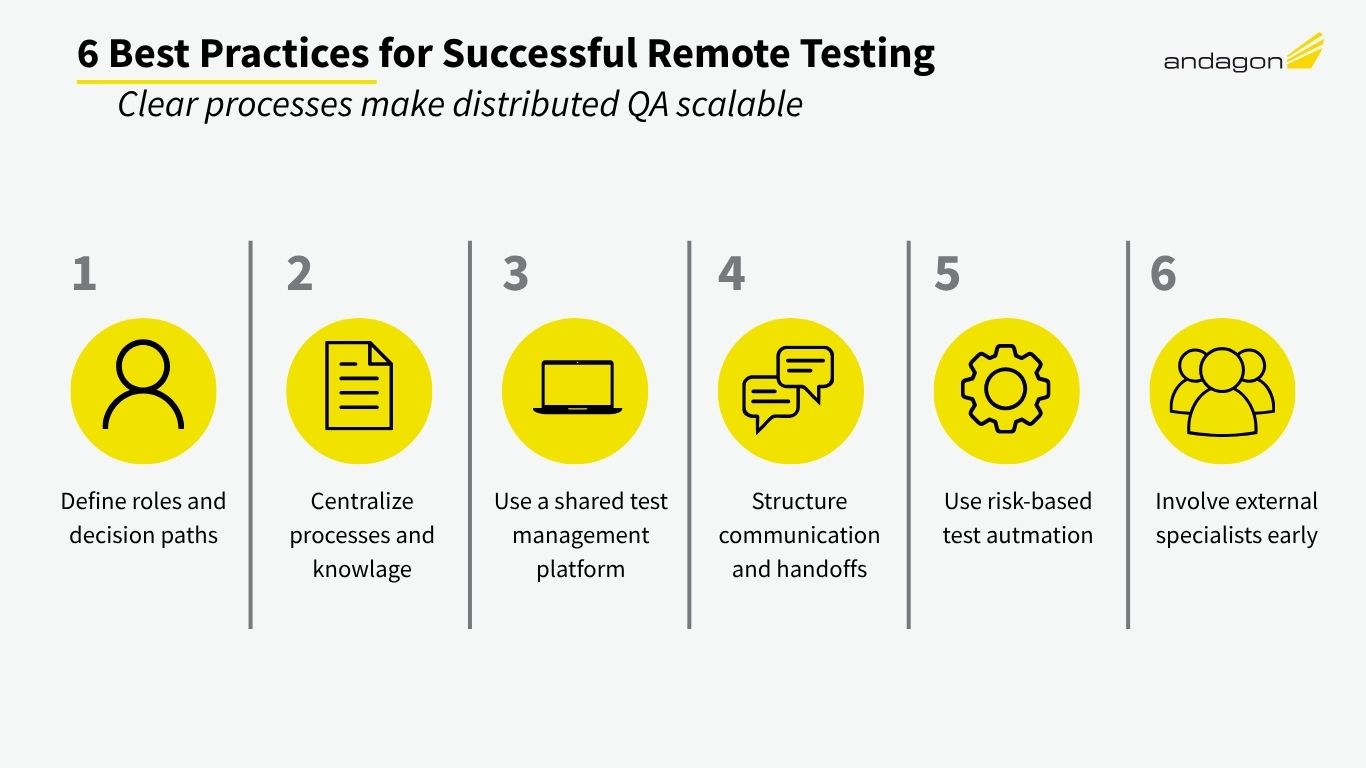
1. Clearly Define Roles and Decision-Making Responsibilities
Tasks, responsibilities, decision-making authority should be clarified before testing activities begin.
A responsibility matrix can make ownership transparent. In particular, clarify:
- Who is responsible for testing activities?
- Who prioritizes defects?
- Who makes decisions when requirements conflict?
- Who receives escalations about quality risks?
- Who approves testing and releases?
Clear responsibilities reduce follow-up questions and prevent decisions from getting stuck between different locations or teams.
2. Centralize Process and Knowledge Documentation
Testing procedures, defect workflows, reporting, approval, and escalation processes should be documented consistently and made centrally accessible to all authorized stakeholders.
The same applies to requirements, test strategies, and relevant decisions. Reliable documentation facilitates handoffs, reduces dependencies on individual team members, and accelerates onboarding.
3. Use a Shared Test Management Platform
Requirements, test cases, test runs, defects, and test results should be managed centrally and linked wherever possible. This makes it possible to trace which requirements have been tested, which tests have already been executed, which defects remain open, and which quality risks affect a release.
Ideally, the test management platform should integrate with existing development, ticketing, and collaboration systems. This reduces duplicate data entry and disconnected workflows.
For distributed teams, such a platform provides a shared information base for quality-related decisions.
4. Establish Clear Communication and Handoff Processes
Teams should define which information is shared through which channel, when synchronous communication is necessary, and where decisions are documented.
Structured handoffs are particularly important when teams work asynchronously. Open tasks, test results, defects, risks, and next steps must be documented so that other team members can continue working immediately.
The goal is not more meetings, but clear processes and traceable outcomes.
5. Use Test Automation Strategically for Distributed Teams
Test automation can help distributed QA teams execute recurring checks reliably regardless of location and working hours. Automated regression tests provide a shared and reproducible information base that everyone involved can access.
This is particularly useful for stable tests that are executed regularly. Decisions about which test cases to automate should still be based on business risk, manual effort, and the expected value of automation. Test automation complements test analysis; it does not replace it.
6. Involve External Specialists Early
External testers should not be brought in only immediately before a testing phase begins. Especially in remote testing, they need early access to relevant information about system dependencies, business processes, quality objectives, and risks.
The better this context is documented and accessible, the faster external specialists can become productive within a distributed team and the lower the additional coordination effort.
When Is Remote Testing Particularly Valuable?
Remote testing is particularly useful when testing activities can be clearly defined, collaboration can be organized digitally, and the required expertise does not need to be permanently available on site.
The model is particularly well suited to releases and migrations with temporarily increased testing demand, situations where specialized expertise is unavailable internally, and permanently distributed development organizations. Remote testing is less suitable when key requirements, responsibilities, or access processes are still unclear. In that case, the underlying QA processes should be stabilized first.
How andagon Integrates Remote Testing Into Existing QA Structures
External testing resources deliver the greatest value when they do not operate as an isolated testing unit but are integrated into existing processes, systems, and responsibilities.
Operational Support for Day-to-Day Testing
Our testing experts support existing teams with activities including test design, test execution, test automation, and defect management. The collaboration is aligned with the client's existing development and testing processes.
Further Develop QA Structures
Remote testing can also reveal where processes still depend too heavily on individual team members or informal coordination.
When needed, we therefore work with our clients to further develop testing processes and test strategies, establish test automation, or optimize reporting and approval processes.
In addition to operational capacity, this creates knowledge transfer that remains useful within the organization even after the engagement ends.
Checklist: Is Your QA Ready for Remote Testing?
Before distributing testing activities or bringing in external testers, assess whether your QA processes can function without relying on informal, in-person coordination.
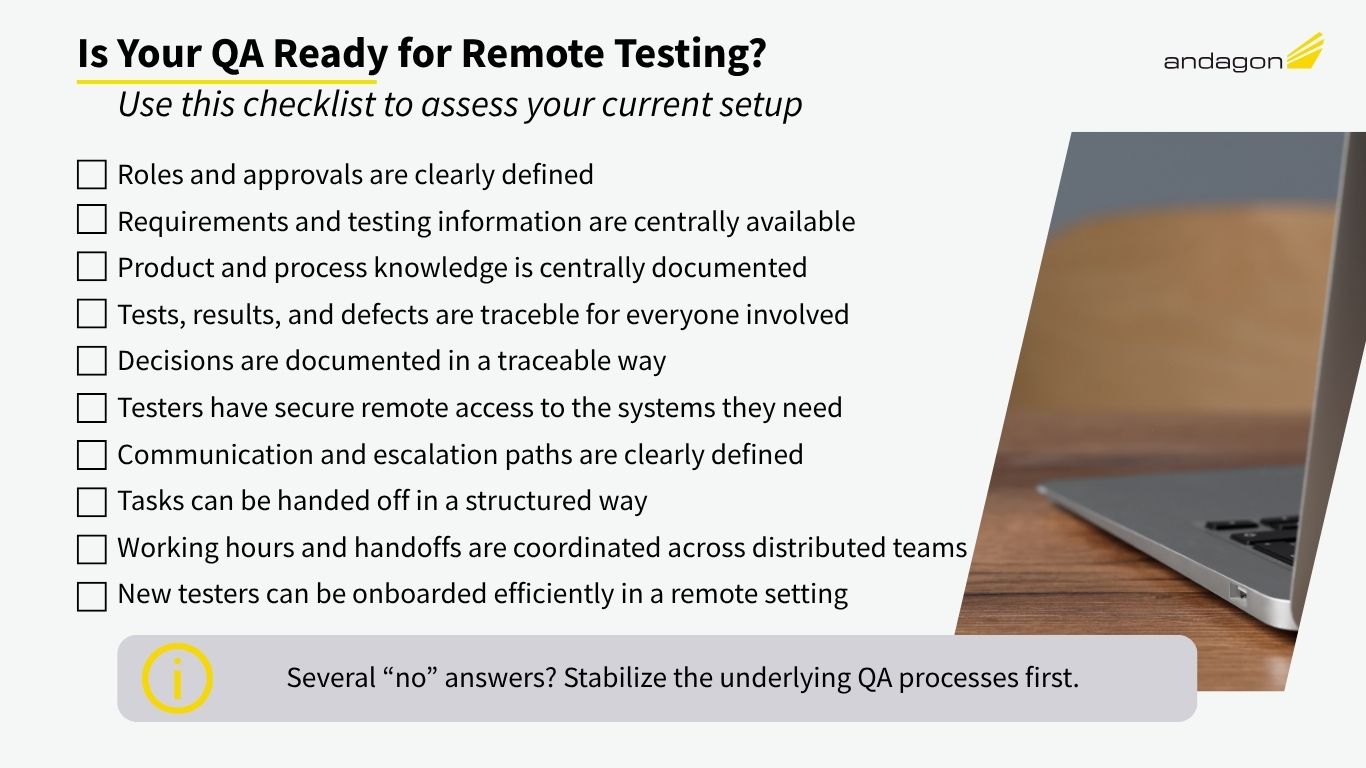
In particular, assess whether roles and approvals are clearly defined, requirements and testing information are centrally available, and relevant decisions are documented in a traceable way. Equally important are secure remote access, clearly defined communication and escalation paths, structured handoffs, and efficient remote onboarding for new testers.
Several “no” answers do not mean that remote testing is unsuitable for your organization. Instead, they show which processes should be stabilized or more clearly defined first.
Conclusion: Remote Testing Is an Operating Model for Scalable QA
Remote testing enables companies to bring in the QA expertise they need regardless of location and adjust testing capacity to changing project requirements.
Success, however, does not depend solely on whether testing activities can technically be performed remotely. Clear processes, well-defined responsibilities, reliable documentation, structured communication, and secure technical access are what make the model work.
When implemented effectively, remote testing relieves internal teams and creates greater flexibility for releases, migrations, and unexpected testing needs. The model delivers the greatest value when it is treated not as an isolated staffing measure but as part of an overarching testing strategy.
Would you like to assess which testing activities can be effectively handled remotely within your existing QA structure? Our testing experts can help you develop the right structures, integrate the expertise you need, and make your quality assurance more flexible.

