
Comprehensive test management solution for complex challenges.

Software Quality Management for Stable Releases
andagon Team
in
#Software Testing
#Quality Assurance
#Test Management
·
01.06.2026
·
13 min. reading time
Learn how software quality management helps organizations reduce release risk, improve delivery reliability, and make better go-live decisions
Software quality management determines whether releases are predictably and consistently delivered. Those who only test do not make reliable delivery decisions. We are talking about goals, rules, and measurements — not just tools. Properly understood, software quality management is the operating system for quality: it makes risks visible early, protects delivery capacity, and creates a decision-making framework for development, operations, and management. Read on if you want fewer surprises and more reliability because we translate principles into practical routines that create measurable impact. The result: predictable delivery through software quality management.
Fundamentals: What Does Software Quality Management Actually Achieve?
Many teams believe quality emerges automatically when good developers test well. That is wishful thinking. Quality emerges when goals, responsibilities, and decision paths are clearly defined and consistently practiced every day. Software quality management is not additional overhead, but a governance framework for risks that connects development, operations, and business. Ignoring this leads to unforeseen outages, late-night firefighting, and a loss of credibility with management. The goal of SQM is to increase customer satisfaction through high product quality, reliability, and defect prevention.
Quality as a Leadership Responsibility
Quality is a leadership decision. Without measurable quality goals, every discussion remains subjective. Define accepted defect classes, service targets, and tolerances. Decide which risks are acceptable — and which are not. Only then can teams prioritize effectively. A clear quality vision creates alignment for design, development, testing, and operations. It prevents the loudest voice in the room from making the decisions.
From Gut Feeling to Measurable Control
A gut feeling is not scalable. Effective quality management builds a reliable measurement system. Defect rates, test coverage, code health, performance, and operational stability must be viewed together. What matters is condensing them into a few leading metrics with clearly defined thresholds. Trends matter more than isolated snapshots. This allows organizations to identify setbacks early and act before it becomes expensive. Structured quality management also enables companies to collect extensive operational data that serve as the basis for data-driven process optimization and decision-making.
Framework: What Does Software Quality Management Include?
The framework includes governance, quality goals, policies, processes, roles, metrics, and continuous improvement. Testing is one building block — not the entire discipline. Reviews, definitions of done, quality gates, risk assessments, and incident learnings complete the picture. Together, they create a cycle of planning, execution, validation, and adaptation that makes quality predictable.
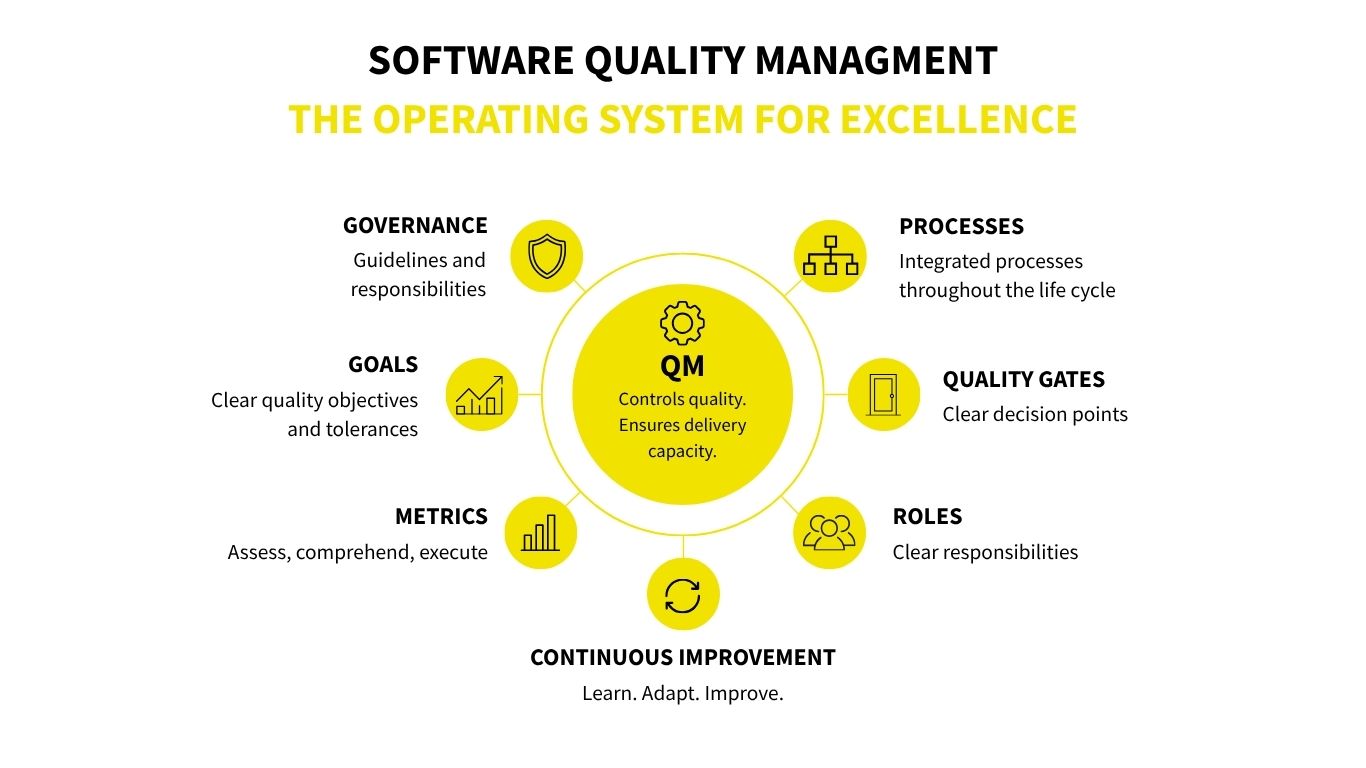
- Establish a shared language for risks and quality
- Define a small number of meaningful KPIs with target values
- Introduce quality gates at critical handover points
- Make continuous improvement routines mandatory
This turns quality into a managed discipline rather than a delegated task. It reduces friction, shortens feedback loops, and increases delivery reliability. Those who make quality visible create trust for both engineering and business.
Software Quality Management vs. Testing vs. QA
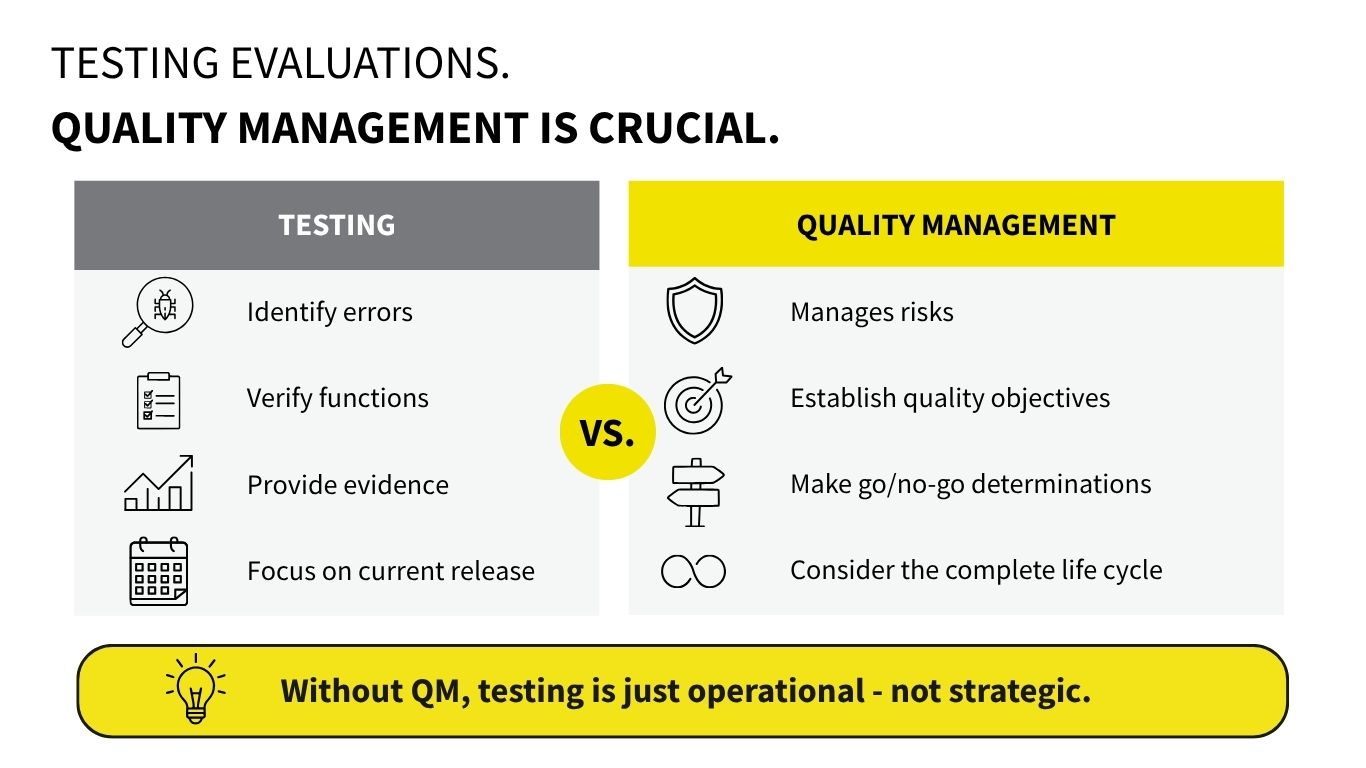
Many organizations confuse disciplines. Testing finds defects. Test management coordinates testing activities. Traditional quality assurance documents compliance. None of these disciplines manage risk across the entire lifecycle. Software quality management operates at a higher level: it defines goals, sets guardrails, and creates the basis for reliable go-live decisions.
Testing Validates — Management Governs
Testing is an activity. It provides evidence, but not decisions. Management determines what evidence is sufficient, how deeply systems must be validated, and when residual risk is acceptable. It prioritizes where quality has the greatest impact instead of testing everything equally. This shift saves time and avoids wasted effort.
Test Management Coordinates, QA Anchors Processes
Test management plans, controls, and reports testing activities. A cross-functional software testing strategy ensures that processes are followed and evidence exists. Both are valuable, but neither replaces the leadership function of managing quality as a product and business risk. Without this layer, organizations remain operationally busy but strategically blind.
Where Software Quality Management Begins and Ends
SQM starts with defining measurable goals and ends with improvements made after an incident. It spans architectural decisions, coding standards, build pipelines, testing strategy, release gates, and operational monitoring. Professional software testing and IT quality assurance services ensure that insights from production and support are fed back into the roadmap. Only this cycle provides true controllability.
- Testing: creates evidence
- Test management: organizes evidence
- Quality assurance: ensures compliance
- Quality management: governs risks through goals and decisions
Organizations that clearly separate — yet integrate — these responsibilities avoid duplication and gaps. The result is a lean and effective quality flow that accelerates instead of slowing down delivery.
Relevance for Decision-Makers: How Software Quality Management Controls Risk and Cost
CIOs and engineering leaders constantly operate between delivery pressure and risk. Delivering too late costs market opportunities. Delivering with too much risk costs trust and support capacity. Software quality management provides the decision-making logic between those extremes. Managed testing services that scale software testing make it visible how safe a release really is, what the impact of postponement would be, and where investments have the greatest effect.
Reducing Decisions Under Uncertainty
Uncertainty never disappears. It must be managed. Effective quality management systematically separates known risks from unknown ones. It prioritizes safeguards where business impact is highest. It prevents teams from wasting capacity on low-value risks. This leads to faster and more consistent decisions — even when information is incomplete.
Translating Business Risks into Engineering Language
Technical metrics only matter to the business when they support business goals. Translate SLO violations into customer impact, defect density into warranty risk, and stability indexes into delivery probability. This translation creates budget clarity and prioritization. It prevents endless tool debates and focuses attention on outcomes.
Questions That Software Quality Management Reliably Answers
Quality management answers the questions that actually matter in day-to-day operations. It creates structure for repeatable go-live decisions and enables organizations to actively manage risks instead of reacting to them after the fact.
- How high is the current release risk, and what influences it?
- Which countermeasures provide immediate impact, and which provide long-term stability?
- What is the real cost of postponement compared to a hotfix?
- How do current changes influence the stability of future delivery cycles?
These answers create calm in high-pressure situations. They build trust among stakeholders and reduce firefighting. Those who make risks visible can manage them and keep costs predictable.
Risks of Poor Software Quality Management: Why Projects Lose Their Rhythm
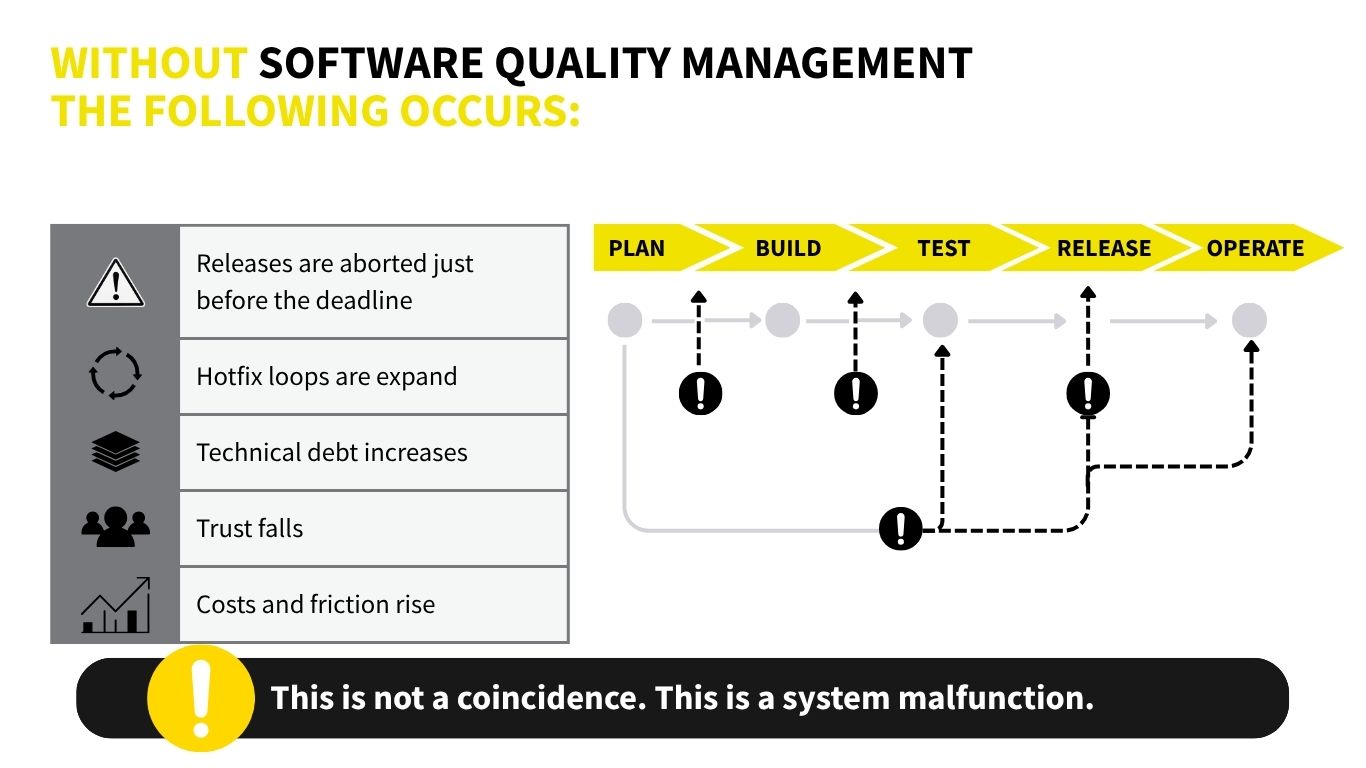
Without clear quality leadership, teams delay decisions. Defects move through phases, tickets age, and releases fail shortly before launch. This is not bad luck. It is a system failure: missing goals, missing gates, and missing measurements. The result is stress, the blame game, and lost weeks. There is a better way.
Missing Guardrails Create Expensive Waste
When quality criteria are unclear, endless discussions emerge. Developers polish details nobody needs while critical risks remain invisible. Teams start too many things simultaneously and finish too little. Throughput drops. Simple guardrails such as definitions of ready and done immediately improve productivity and quality.
Late Quality Is the Most Expensive Quality
Every phase a defect survives multiplies its cost. Late testing cannot replace early risk reduction. Architecture reviews, pairing, static analysis, targeted load and stress testing, and early integration uncover major defect classes much earlier. These measures save time across the entire system — not just inside the testing team.
Early Indicators Provided by Software Quality Management
Defect trends in early phases, stability metric deviations, and rising reopen rates are warning signals. They show quality erosion before customers feel the consequences. Effective management makes these indicators visible, links them to actions, and enforces consequences at quality gates while aligning with modern software testing and quality assurance trends.
- No shared risk understanding between product, engineering, and operations
- Expanding hotfix loops and increasing incident pressure
- Technical debt without a repayment strategy
- Loss of trust in commitments and roadmaps
Organizations that recognize and stop these patterns regain delivery rhythm. Quality is not tested later — it is led earlier. This reduces stress and increases delivery reliability.
Building Blocks of Effective Software Quality Management: Goals, Processes, Roles, Metrics
Without architecture, there is no house. Without building blocks, there is no quality management. Individual measures achieve little if the overall framework is missing. Effective organizations establish a few robust mechanisms and apply them consistently. It sounds unspectacular — and that is exactly why it works. Clear structures and organizational frameworks are critical for implementing standards such as ISO 9001 and defining responsibilities transparently. Industry associations and quality partnerships support this with best practices and training standards.
Goals and Policies First
Start with a few measurable quality goals. Define policies for security, performance, maintainability, and supportability. Set tolerances and exceptions. Without these guardrails, teams drift into endless tool debates. With them, architecture, testing, and operations align with shared goals.
Processes, Roles, and Automation in Sync
Processes make expectations binding. Roles clarify accountability. Automation reduces variability. Define who evaluates risks, who decides at gates, and how evidence is created. Integrate these decisions into CI/CD instead of recreating them manually in meetings. This reduces cycle time without sacrificing quality.
Modern quality management software and specialized providers for test automation and software quality assurance help organizations centrally govern and manage quality processes, leading to improved product quality and efficiency. Effective QM software automates quality processes, minimizes human error, and optimizes resource usage. Specialized partners in test management, test automation, and quality assurance help integrate this automation into engineering and testing workflows. Implementing QM software can also increase acceptance of quality management systems by creating transparency and involving employees more directly.
Building a Measurement System for Software Quality Management
Choose a few leading indicators: release risk score, stability index, defect flow, reopen rate, and MTTR. Measure where work actually flows — not in isolated reporting spreadsheets. Visualize trends and thresholds. Link metrics to concrete responses. Metrics without consequences are just decoration.
- Define quality goals and policies
- Establish quality gates and responsibilities
- Select and consistently use metrics
- Institutionalize continuous improvement
These building blocks create a system that enables repeatable decisions. Less discussion, more impact. That is the foundation for stable releases.
Stable Releases: How Software Quality Management Creates Predictability
Stability is not an accident. It is the result of clear quality goals, clean handovers, and honest metrics. Those who only test at the end are gambling. Those who lead quality consciously manage risks, plan buffers intentionally, and make transparent decisions. This creates predictable releases without sacrificing speed.
Predictability Comes from Defined Quality Goals
Without target values, no one can say whether enough testing has been done. Quality goals define how safe a release must be. This determines what evidence is required. Teams test more selectively instead of simply testing more. This saves time and increases confidence. Predictability increases as uncertainty decreases.
Delivery Capability Requires Aligned Quality Gates
Quality gates are decision points with clear criteria. They consolidate evidence and enforce explicit go/no-go decisions. This prevents hidden compromises shortly before go-live. Gates belong in CI/CD pipelines, product decisions, and operational handovers. Clearly defined escalation paths preserve delivery rhythm.
How Professional Software Testing Supports Release Stability
Management creates a repeatable path from idea to operations. It prioritizes risk mitigation, enforces evidence, and feeds learnings back into the next iteration. Stability becomes a property of the system — not a hope placed on individual teams.
- Risk-based testing depth for each change class
- Automated regression with meaningful smoke and health checks
- Definitions of ready and done as mandatory guardrails
- Release reviews with strict go/no-go criteria
Organizations working this way reduce surprises. Releases become uneventful — and that is exactly the goal.
Typical Mistakes: When Software Quality Management Exists but Fails
Many organizations believe they have quality management because they own tools, testing plans, and reports. Yet the expected impact never appears. The reason is simple: the leadership function is missing. Without clear goals, consequences, and learning loops, even the best processes become meaningless.
Too Many Metrics, Too Little Consequence
Dashboards look impressive when nobody is accountable for acting on them. Less is more. Choose a small number of metrics with clear triggers. Define which actions follow threshold violations. Communicate these rules transparently. This builds trust in numbers and decisions.
Documentation Does Not Replace Real Practice
Process manuals are useless if they do not reflect daily reality. Integrate quality criteria directly into pull requests, pipelines, and ticket templates. This creates quality assurance within the actual workflow. Deviations become visible and can be addressed quickly.
Why Software Quality Management Often Starts Too Late
If quality begins during testing, it already starts too late. Risks must be identified and addressed earlier. Architecture decisions, interface contracts, and performance assumptions should be challenged before large amounts of code exist. Prioritize exploration now – not later.
- Tool and process focus without leadership goals
- Quality introduced too late in the value chain
- Unclear ownership for risk and go-live decisions
- Missing learning loops from incidents and post-mortems
Organizations that eliminate these mistakes immediately increase effectiveness. Quality becomes a decision-making capability instead of a documentation exercise.
Pragmatic Introduction: Building Software Quality Management in 90 Days
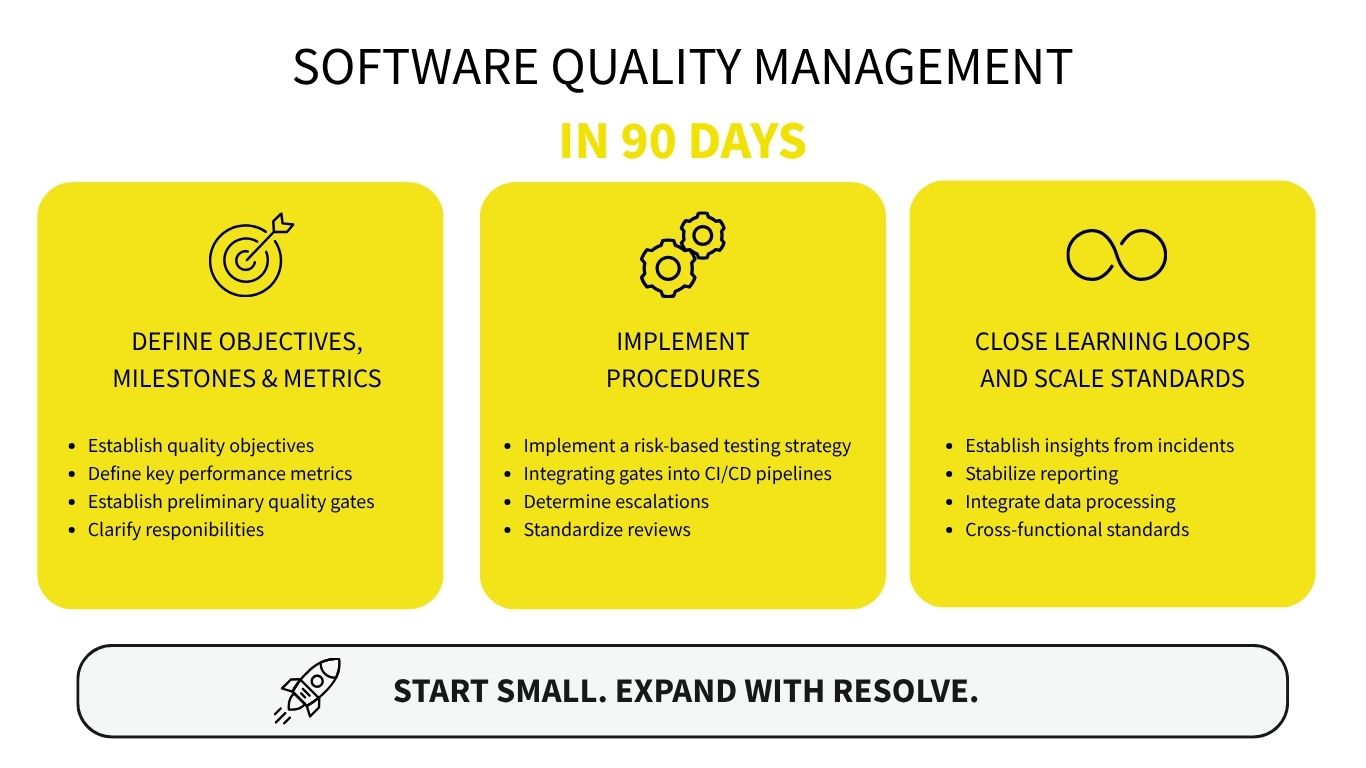
You need impact — not a multi-year transformation project. A minimal but effective system can be established within 90 days. The key lies in focus, clear decisions, and integration into the daily workflow. Start small, demonstrate value, and scale intentionally. This creates value rather than mere action for action’s sake.
Start with the Smallest Effective System
Select one pilot team and one business-critical release. Define three quality goals, two quality gates, and five leading metrics. Integrate them into the delivery pipeline. Establish clear escalation paths. Evaluate weekly. Communicate successes and bottlenecks openly. Predefined quality assurance packages with testing plans and services can help quickly establish structure and execution capacity.
A 90-Day Roadmap with Visible Results
Work in three 30-day phases with clearly defined outcomes. Each phase must produce visible value. Stakeholders see progress, and teams experience relief. Flexible software testing support from external QA experts can absorb peak workloads during these phases. This builds confidence in the approach and motivation for scaling.
Scaling Software Quality Management Across Teams
Scaling succeeds through shared standards combined with local flexibility. Centrally defined goals and metrics coexist with team-specific practices. Communities of practice and targeted QA training and testing seminars support knowledge sharing and capability building. Regular portfolio reviews connect product, engineering, and operations. This keeps direction stable while allowing flexible execution.
- Days 1–30: Define goals, gates, and metrics and integrate them into CI/CD
- Days 31–60: Roll out risk-based testing strategies and establish reviews
- Days 61–90: Close release and incident learning loops and stabilize reporting
- After day 90: Scale standards across teams and continuously improve
This path delivers fast, measurable results while simultaneously building a sustainable system. That is exactly what growing organizations under delivery pressure need.
Quality Sets the Pace: Deliver Reliably, Control Risks, Build Trust
Quality becomes predictable when goals, measurement, and consistency come together. Organizations that operate this way deliver more reliably and gain confidence in decision-making.
Mid-sized companies, enterprises, or transformation programs: the principle remains the same — only the scale changes. A few robust rules outperform endless exceptions.
Focus on clear quality goals, lean quality gates, and meaningful metrics. Embed everything directly into the workflow — not into slide decks.
We support assessment, design, and implementation with a focus on measurable impact and scalability. Interested? Get in touch or contact us directly about test management and software testing services.
FAQ
What Is Software Quality Management?
It is the leadership framework that defines quality goals, processes, roles, and metrics, actively manages risks, and enables reliable delivery decisions. Testing is one component — but not the entire discipline. The goal is predictability, stability, and effective risk reduction.
How Does Software Quality Management Differ from Testing?
Testing creates evidence about the current state. Quality management defines what evidence is needed, prioritizes risks, establishes quality gates, and makes go-live decisions. It governs the entire lifecycle through goals and consequences — not just isolated testing activities.
Why Do CIOs Need Software Quality Management?
It translates business risks into technical governance, creates reliable go-live decisions, and makes budgets more effective. This reduces surprises, supports load, and reworks costs while increasing delivery reliability and strengthening trust among executives and customers.
Which Building Blocks Belong to Software Quality Management?
Core building blocks include quality goals and policies, quality gates, clear responsibilities, a focused KPI system, integrated reviews, risk-based testing strategies, and closed learning loops from incidents and post-mortems. Everything is embedded into CI/CD and daily team routines.
How Does Software Quality Management Create Stable Releases?
Through defined quality goals, clear gate evidence, risk-based testing depth, and trend monitoring of leading indicators. Decisions become straightforward, risks are addressed early, and hotfix pressure decreases. As a result, releases become more predictable and uneventful.
How Can We Best Start with Software Quality Management?
Start with one pilot team, a few goals, two quality gates, and five KPIs. Integrate everything into the delivery pipeline, review progress weekly, and establish learning loops from incidents. Then scale standards across teams while allowing for local adaptation.

