
Comprehensive test management solution for complex challenges.

Test Automation Is Not a Cost Factor — It's Your Competitive Advantage
andagon Team
·
22.10.2025
·
11 min. reading time
Unlock your competitive edge with strategic test automation. Learn how faster delivery, consistent quality, and optimized team capacity create real business value. Discover how a systematic, tool-agnostic approach transforms QA from a bottleneck into a growth driver.
Your greatest competitive edge doesn’t come from having the latest technology or the lowest price. It lies in how quickly you can deliver high-quality software. Test automation is the leverage that makes this possible — when applied correctly.
Imagine your testing pipeline as a precisely tuned clockwork mechanism: if one gear jams, the entire system grinds to a halt. For many companies, this is exactly how test automation works — it starts off promising, but as soon as requirements change or tests stall, the whole mechanism breaks down.
In their German-language webinar “Warum Testautomatisierung? – Probleme und Lösungen moderner QA-Abteilungen” Jonathan Weinhold and Tom Noll from andagon demonstrate how to keep your testing clockwork running smoothly over the long term. Rather than viewing automation as a necessary evil, they position it as a strategic driver of growth and quality assurance. This mindset not only delivers outstanding results but also ensures that automation becomes your competitive advantage rather than a stumbling block.

The Business Case That Devours Your Budget (and Why You’re Asking the Wrong Question)
Have you ever been in this situation? You’re in a meeting when the CFO asks, “When will test automation pay off?” Everyone turns to you, expecting a clear answer, while you juggle hourly rates and saved labor costs in spreadsheets. After two hours of calculations, you arrive at a payback period of 18 months — yet skepticism lingers.
The problem isn’t your math. It’s the question itself. Instead of asking when automation pays off, you should be asking: What does poor software quality actually cost us?
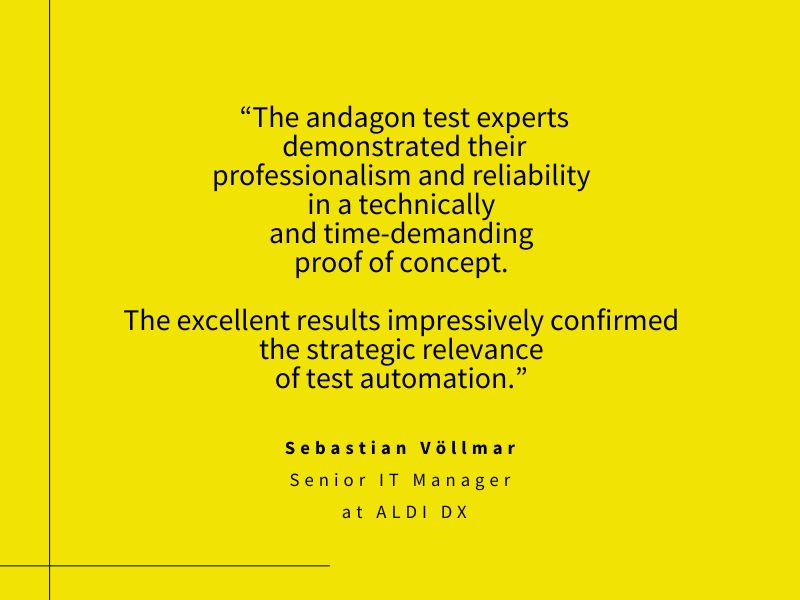
At ALDI DX, the team flipped the perspective. Rather than painstakingly justifying why automation was necessary, they calculated the cost of not automating. The outcome was so compelling that Sebastian Völlmar, Senior IT Manager at ALDI DX, noted: ““The andagon test experts demonstrated their professionalism and reliability in a technically and time-demanding proof of concept. The excellent results impressively confirmed the strategic relevance of test automation.”
The PoC was completed 20% ahead of schedule — not by chance, but through the right approach. andagon didn’t just install tools and hope for the best; they systematically identified where automation would have the greatest impact. Read the reference.
Other customer projects show even stronger results. A structured analysis revealed the biggest potential in test data creation. The initial test data effort per release dropped from 72 hours of manual work to just 3 hours with an automated script. What once kept an entire team busy for three days now runs in a single morning — cutting test time and costs by up to 70%.
Why Most Automation Projects End Up Like IKEA Furniture Without Instructions
Picture this: you’re assembling a wardrobe. You tear open the box, skip the instructions, and start screwing parts together. Three hours later, you’ve built something that vaguely resembles a wardrobe — but the doors hang crooked, and two screws are still lying on the floor.
That’s how most companies approach test automation. They buy the latest “revolutionary” tool hyped by sales and dive right in. The outcome? Automated tests prove more unstable than manual ones, maintenance takes longer than it saves, and initial enthusiasm fades within six months.
As Tom Noll explains in the webinar, “Most companies want to build the roof before the foundation is laid.” They automate tests that are already unstable manually, lack a clear test strategy, have undefined test data, and operate in unstable environments — then wonder why automation fails.
andagon takes a different approach. Instead of starting with tools, they begin by analyzing your existing testing processes: Which tests are truly stable? Which are frequent enough to justify automation? What data is needed, and how can it be reliably provided?
This systematic approach delivers measurable success. andagon’s customers rate them with a Net Promoter Score of 9.4 out of 10 — a figure even Apple and Tesla would envy. That kind of trust doesn’t happen by chance. It’s the result of treating test automation as a strategic initiative, not a technical experiment.
Understanding ROI Correctly: It’s Not Just About Saved Hours
Forget everything you’ve heard about ROI calculations in test automation.
The classic formula — “saved hours × hourly rate” — tells only half the story. It overlooks the true value of test automation.
The real ROI lies in three areas no spreadsheet can capture:
1. Speed becomes a competitive advantage. If your competitors need three weeks for a release and you need only three days, you can respond faster to market changes, deliver new features sooner, and incorporate customer feedback more quickly. This agility may be hard to express in euros or dollars — but it often decides the difference between market success and failure.
2. Quality becomes consistent. Manual tests are vulnerable to human factors — fatigue, time pressure, or just a bad day can let critical errors slip through. Automated tests don’t have bad days. They execute with the same precision at 3 p.m. on a Friday as at 3 a.m.
3. Capacity is freed up. Your best testers spend less time on repetitive work and more time on strategic analysis — designing new tests, identifying edge cases, and improving the test architecture. This qualitative shift compounds into exponential returns over time.
The example above illustrates this perfectly: 72 hours of manual test data preparation were reduced to just 3 hours through automation. But that’s only the tip of the iceberg. With their time freed up, the team tackled more complex test scenarios and cut overall test costs by 70%.
This isn’t just efficiency — it’s transformation.
Tool Independence: Why Vendor Lock-In Is Your Greatest Enemy
One of my favorite analogies: Most test automation vendors are like furniture stores claiming to sell you a home. Need a bed? Here’s one in bright orange with polka dots. Doesn’t match your décor? No problem — just paint the rest of your house orange with polka dots.
andagon takes a different approach. We’re completely tool- and vendor-independent. If Selenium is the right fit, we recommend Selenium. If Tosca works better, we use Tosca.
This flexibility proved essential at ALDI DX. For 60% of their requirements, standard Tosca functions were sufficient. For the remaining 40%, andagon developed custom workarounds and extensions. The result: a solution precisely tailored to ALDI DX’s needs — without paying for unnecessary, expensive licenses.
Vendor lock-in quietly kills many automation projects. You start with a tool that fits your first use case perfectly, but as your organization and needs evolve, you hit its limits. Then you’re forced either to adapt your processes to the tool’s constraints or to switch tools and start from scratch — both costly in time, money, and nerves.
With a tool-independent partner, you avoid this trap. You can choose the best solution for each use case and even combine tools when needed. It may seem more complex at first, but it gives you the flexibility to grow without compromise.
Test Management: The Underrated Foundation of Successful Automation
Jonathan Weinhold made an observation that seems paradoxical at first: companies with the best test automation also have the best manual test management. But this isn’t a coincidence — it’s pure logic.
Test automation is only as strong as the tests it automates. If your manual tests are disorganized, your automated tests will be too. Without clear test cases, you can’t create clear automation scripts. Inconsistent test data inevitably leads to unstable automation.
That’s why every andagon project starts with a thorough assessment of existing test management: Which tests already exist? How are they documented? How is test data handled? Which tests are suitable for automation — and which should remain manual?
This groundwork may not sound glamorous, but it’s indispensable — like the foundation of a house: invisible, yet essential. A poorly prepared automation project is like building on sand — it might look stable at first, but it will collapse under pressure.
The proof-of-concept approach shown in the webinar follows exactly this logic. It begins by analyzing your systems and processes, identifying suitable tools, uncovering weaknesses, and highlighting areas for improvement. Only then can a solid, reliable plan be created. This step-by-step approach minimizes risk and dramatically increases the likelihood of long-term success.
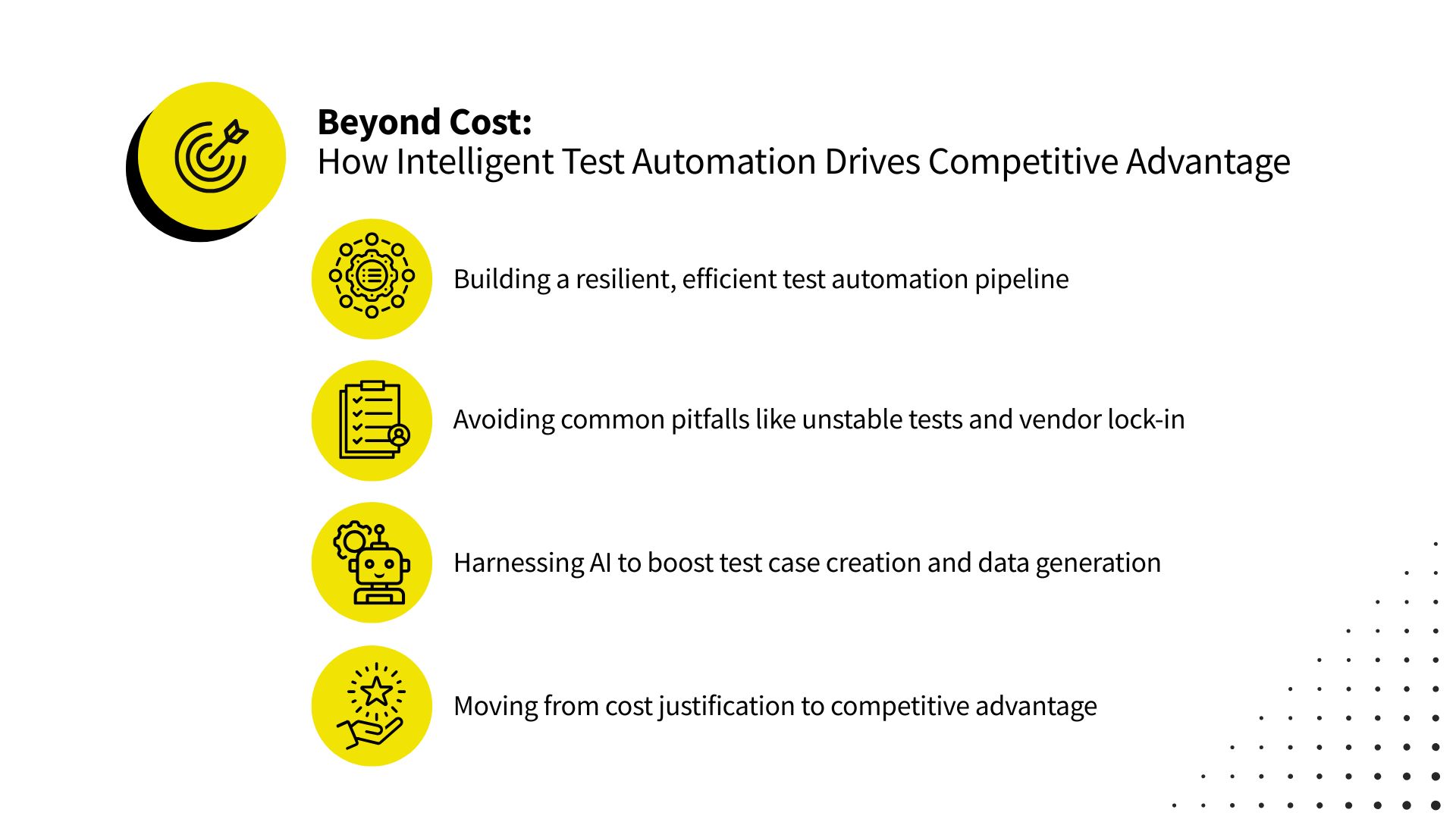
AI in QA: Between Miracle Cure Promises and Practical Benefits
Artificial intelligence sparks strong opinions. Some hail it as a game changer; others dismiss it as hype. In quality assurance, the truth lies somewhere between marketing claims (“AI solves all your testing problems!”) and practitioner skepticism (“It’s just hype!”).
Tom Noll and Jonathan Weinhold provide a realistic perspective: AI isn’t magic — it’s about extracting concrete benefits and understanding what’s feasible today.
Two AI-driven innovations are currently setting new standards:
➤ AI-supported generation and maintenance of test cases: Modern tools can automatically generate and update test cases from requirements — whether in text, audio, or document form. Structured requirements are quickly and consistently transformed into testable scenarios. Integrated with platforms like aqua, AI applies ISTQB standards to produce reliable, traceable test cases, reducing errors and saving time. Key point: clearer requirements lead to better results.
➤ Automated generation of robust test data: Creating test data has long been a bottleneck. AI can now produce realistic, diverse synthetic test data, enhancing quality and data privacy by avoiding the use of real data — and thereby reducing breach risks. Teams can focus on test logic rather than manual data preparation.
These AI-enhanced approaches complement rather than replace existing test strategies, boosting efficiency with minimal extra effort.
Other promising AI trends in QA include predictive analytics and requirements traceability:
Predictive analytics forecast defects and prioritize tests based on code changes and project history. This shortens test cycles and identifies critical bugs earlier but relies on solid historical data (at least six months). Its effectiveness is limited for brand-new features.
Requirements traceability provides full transparency by linking requirements, test cases, and code — even across semantic differences. Benefits include rapid detection of changes and cleaning up inconsistent data. Success depends on data quality and structured processes, making implementation and training time-intensive. Quick wins are rare; proof-of-concept pilots are recommended before major investments.
What AI Cannot Do: Replace Your Expertise
AI cannot determine whether a test case is business-critical or merely “nice to have.” It cannot judge whether a defect is show-stopping or cosmetic. It cannot interpret stakeholder intent or read between the lines.
The most successful automation projects combine AI tools with human intelligence: AI handles repetitive analysis, while humans make strategic decisions. This synergy is far more effective than either working alone.
Fixed-Price Packages: Predictable Budgets in an Unpredictable World
The most fascinating part of test automation isn’t the technology — it’s trust. Most IT projects fail because of inflated expectations, unclear scope, or ballooning costs — not the technology itself. Test automation is no exception.
andagon developed a model to reduce these risks: Test automation at a fixed price. Instead of billing by the hour, they deliver defined results at a known cost. You know upfront what you’ll get and what it will cost.
Simple, yet revolutionary. Most providers sell time, not outcomes. Estimates often fall short, extra requirements trigger extra costs, and unforeseen issues cause delays — leaving you paying more without necessarily getting better results.
Fixed-price packages flip this logic. andagon assumes the risk for effort estimates and unexpected problems, focusing on delivering agreed-upon results at a fixed cost. This approach provides planning security for you while incentivizing efficient delivery.
The impact shows in customer satisfaction: a 9.4/10 Net Promoter Score isn’t accidental. It comes from exceeding expectations, completing projects on or ahead of schedule, respecting budgets, and delivering measurable results.
Future Trends: DevOps, Cloud, and the Evolving QA Role
The future of test automation is closely intertwined with DevOps. Testing is no longer a final step at the end of development — it’s embedded into every code change. This requires fast, reliable, and fully automated tests.
Cloud-based testing solutions make this easier. Instead of building and maintaining test infrastructure, tests run in the cloud — reducing costs and enabling seamless scalability. Additional resources can be provisioned within minutes.
But the biggest transformation is in people. QA teams are evolving from reactive testers into proactive quality architects. Rather than simply finding bugs, they embed quality into development from day one. This shift demands new skills: test design, automation, and process optimization.
For those ready to adapt, this is a tremendous opportunity. QA is moving from a support function to a strategic driver of faster, higher-quality software delivery.
The Way Forward: From Theory to Practice
Test automation is no longer a vision of the future — it’s today’s reality. The question isn’t if, but how your company will implement it. Success depends on the right positioning.
Don’t view test automation as a cost to justify; see it as a strategic competitive advantage to leverage.
Begin with a thorough analysis of your current test processes. Choose tools that fit your needs, not just the newest or most hyped. And above all, partner with experts with a proven track record of delivering results.
Jonathan Weinhold and Tom Noll’s webinar provides detailed insight into the andagon methodology — an hour well spent that could save you months of trial and error.
For tailored advice, contact Jonathan Weinhold (j.weinhold@andagon.com) or Tom Noll (t.noll@andagon.com). Their test case packages offer low-risk entry points with predictable costs and measurable benefits.
The time for strategic test automation is now. While you deliberate, your competitors are already investing in their future. Take the first step and position test automation as your competitive advantage.

