
Comprehensive test management solution for complex challenges.

Software Test Management for Executives: KPIs
Dana Barnett
in
Test Management
QA Leadership
Quality KPIs
Risk Management
Software Testing
·
24.09.2026
·
13 min. reading time
Software test management for executives decides delivery reliability, customer trust, and roadmap credibility. Treat quality as just a testing activity, and you're managing symptoms. Treat it as a leadership responsibility, and you're managing risk, time, and budget: that's the difference this article is about. We turn testing into business decisions: clear metrics, clear accountability, so you can prioritize with confidence even as pressure and deadlines mount. No tool debates here, just decision-making logic. The benchmark is practical impact. The real value is a governance framework you can actually run.
Software Test Management for Executives: From Quality Vision to Leadership Responsibility
Quality is not a coincidence, but a deliberate decision at the leadership level. Those who only count test cases lose sight of the bigger picture. We regularly see organizations pushing through demanding releases without a shared understanding of quality objectives. The result is artificial crises shortly before go-live, unexpected cost overruns, and lost trust. The good news: a clear leadership framework makes quality manageable. You define objectives, accepted risks, and measurement points. This transforms operational testing into a strategic discipline with an impact on roadmap execution, revenue, and reputation.
What Quality Really Means at the Leadership Level
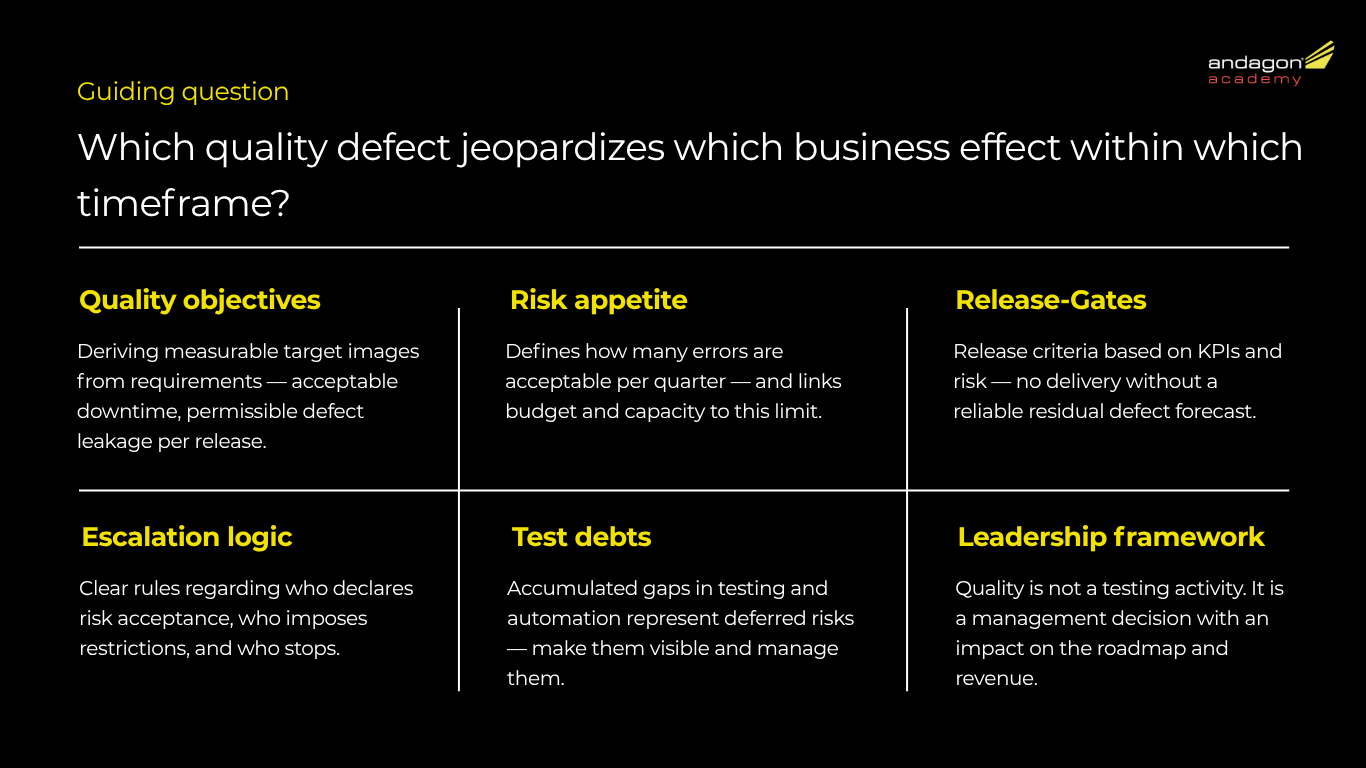
Executives need a definition of quality that considers business value, risk, and delivery capability. This includes measurable target states. To achieve this, the quality definition must be based on test objectives derived from requirements as well as a consistent software testing strategy so that business value, risk, and delivery capability can be assessed. Examples of this include acceptable downtime, permissible defect leakage per release, and licensing conditions for external components. Quality thus becomes a guardrail for decision-making. Priorities are set based on business value and risk pressure rather than the volume of individual stakeholders. The central question is: which quality deficiency threatens which business outcome within what timeframe?
Software Test Management for Executives as a Governance Model
A governance model incorporates principles, roles, and measurement points. It provides a shared vocabulary for risk, maturity, and release decisions. In the traditional approach, the focus is more on planning: test management primarily involves detailed test planning and an initial testing strategy. In addition, you define quality objectives for each product line and establish concrete agreements between business, development, and QA, as well as escalation logic for threshold violations. This replaces subjective discussions with clear rules. The model translates business objectives into operational guardrails. In agile teams, a test manager clarifies responsibilities and increasingly acts as a coach rather than a purely controlling authority. Teams understand when to increase quality efforts, when to release, and how to address risks.
From Slogans to Measurability
The transition from intentions to reliable metrics is what determines effectiveness. You need a small number of robust metrics that can withstand scrutiny in leadership meetings. These KPIs should be derived from a structured testing process and support monitoring testing activities. This includes escaped defects in production, mean time to detect and mean time to recover as well as risk coverage of critical business processes. You should also establish release acceptance criteria based on these metrics. This creates consistency across products and locations, preventing opportunistic shortcuts.
- Consistent quality objectives per product line, with thresholds and tolerances
- Clear roles for decision-making and escalation across teams
- Core metrics that make business risks visible and guide release decisions
- Integration into roadmap, budget, and workforce planning
Organizations that lead this way gain calmer releases, more reliable expectation management, and significantly fewer firefighting situations.
Software Test Management for Executives: Quantifying Risks Instead of Merely Discussing Them
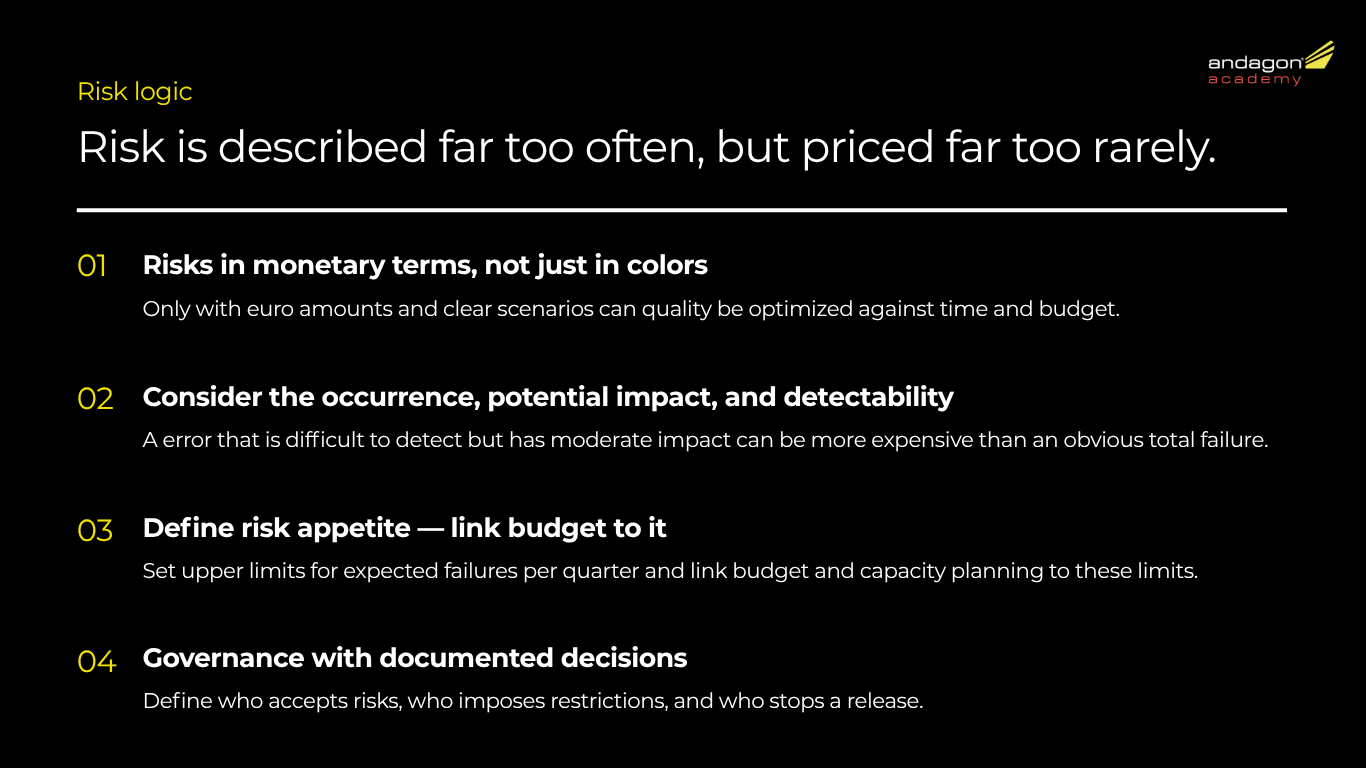
Risk is described far too often and priced far too rarely. This is exactly how companies lose millions. Without quantification, people make decisions based on intuition. This can result in excessive testing in the wrong areas and insufficient protection in critical ones. The solution lies in a pragmatic risk framework that considers the probability of occurrence, the potential impact, and the likelihood of detection. Only when risks are expressed in monetary terms and linked to clear scenarios can quality be optimized for time and budget.
Risk Profile Instead of Gut Feeling
Start with a list of business-critical processes. Consider payment processing, regulatory evidence, and safety-critical embedded systems, for example. Systematically assess how likely failures are to occur and how much they would cost. Model detectability. A defect that is difficult to detect but has moderate impact can be more expensive than an obvious total outage. This risk profile makes clarifies priorities. It enables the development of testing strategies for critical business processes, including targeted load and performance testing in software systems. It helps determine test depth, testing approaches, and release criteria.
Software Test Management for Executives in Risk Portfolio Management
Risk management is portfolio management. Realistic portfolio assessments improve coordination across teams and systems, making prioritization more reliable. Where necessary, external quality assurance service packages for software projects can help close capacity gaps quickly. The key is to balance prevention, protection, and responsiveness. To achieve this, you need to define your risk appetite. Set upper limits for expected failures per quarter and link budget and capacity planning to these limits. Introduce targeted exploratory sprints in high-risk areas. Reduce governance intensity in low-criticality modules when budgets are tight. This creates an allocation model that balances return and resilience.
Governance, Defect Management, and Escalation Paths
Risk decisions require clear accountability. Define who accepts risks, who imposes restrictions, and who can stop a release. Document the basis for every decision. Best practices for escalation and release approval help to ensure that test management decisions remain consistent and traceable. Acceptance should not be a matter of habit but rather be based on transparent metrics and scenarios. Regular risk reviews should be incorporated into steering committees. This creates reliability and prevents the usual last-minute politics. It reduces unnecessary rework loops and strengthens predictability.
- Quantify risks in monetary terms, not just in colors
- Assess probability, impact, and detectability together
- Define risk appetite and connect budget decisions to it
- Strengthen governance through documented decisions
Using this approach, you can avoid costly blind spots and shift discussions from intuition to evidence-based decision-making.
Software Test Management for Executives: KPIs That Support Decisions
Dashboards can be impressive, but they often lack direction. Many metrics measure activity rather than impact. Effective leadership requires a small number of robust KPIs that demonstrate whether quality is sustainable and indicate where corrective action is necessary. KPIs influence budgets, release approvals, and exceptions. We recommend a compact set of leading and lagging indicators that make risk, delivery capability, and customer experience visible. This creates genuine governance rather than reporting for reporting’s sake.
Fewer Metrics, Clear Impact
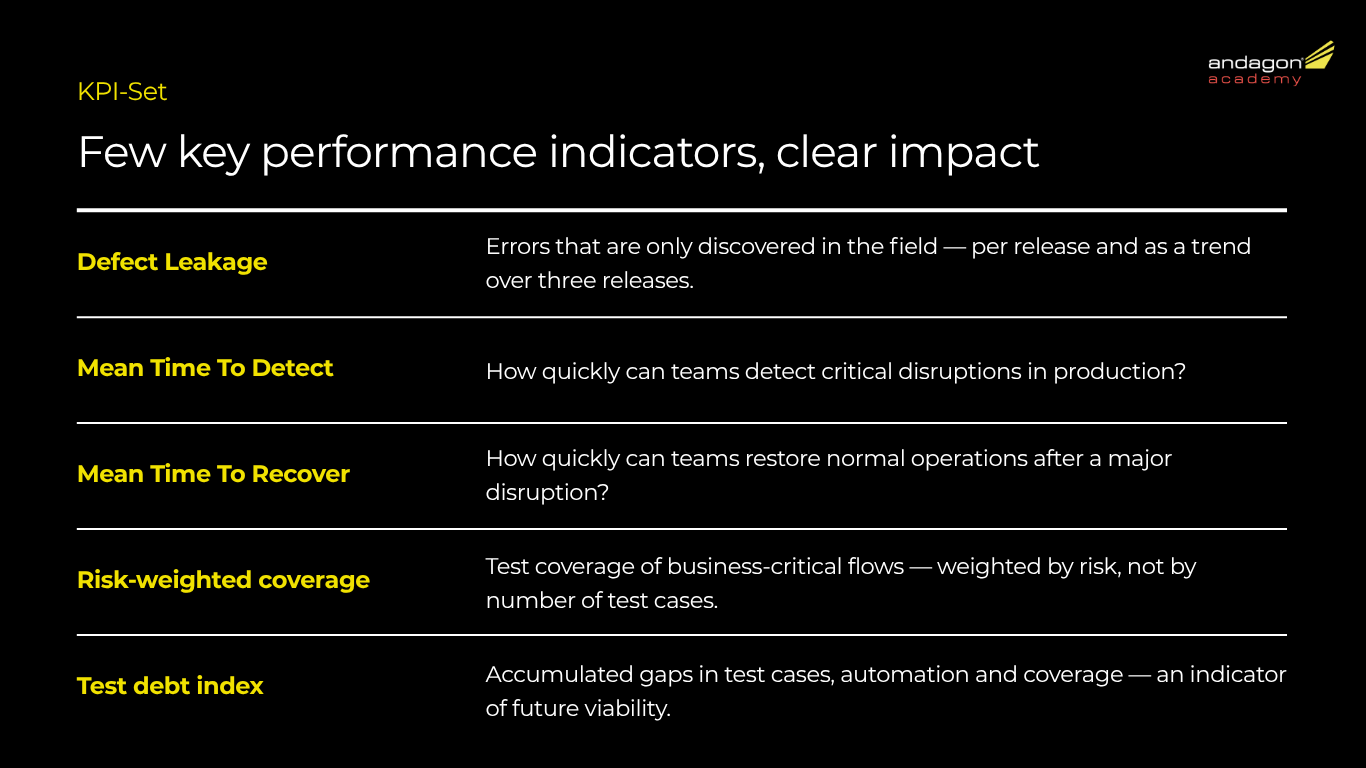
Start with the customer perspective and delivery capability. How many defects make it into production? How quickly do teams detect and resolve critical incidents? How stable are core processes across releases? Add metrics that track the evolution of testing debt. Testing debt consists of accumulated gaps in test cases, automation, and coverage. Consider test analysis and test execution separately because each one exposes different risks and backlogs. At the operational level, clearly defining and managing of test cases within test scenarios support this distinction. This combination reveals whether you are operating at the expense of the future. What matters is not the number of test cases, but their significance for business risks.
Software Test Management for Executives: KPI Set
A practical set of KPIs consists of metrics that reflect business risks. Modern test management tools, such as Jira, TestRail, HP ALM, and specialized test management solutions, provide the foundation for creating and managing test cases because they ensure consistency in planning, tracking, and reporting. These tools automate processes to increase efficiency and the quality of data collection, tracking, and analysis. Each metric requires a definition, a target value, and a corrective action plan in case of deviation. Consistency across teams is essential. This enables fair product comparisons and early identification of structural issues. This set of KPIs belongs in steering meetings and should guide release decisions.
Interpreting Test Management Tools Instead of Creating Dashboard Fireworks
Metrics without context lead to actionism. Require a brief root cause analysis and a corrective action with a deadline for every significant deviation. Do not tolerate cosmetic reporting. Test results should be prioritiyed prioritized through defect management and tracked until their effectiveness has been verified. If defect leakage increases, decide whether additional regression testing or a targeted release freeze is necessary. If MTTR increases, strengthen incident readiness and on-call capabilities. This approach links metrics directly to decisions and produces tangible improvements.
- Defect leakage per release and trend across three releases
- Mean Time To Detect and Mean Time To Recover for severe incidents
- Risk-weighted coverage of business-critical flows
- Testing debt index and automation return on investment per quarter
This brevity and clarity prevent metric overload and strengthen leadership effectiveness under uncertainty.
Software Test Management for Executives: Budget, Resources, and Release Planning
Many organizations cut their QA budgets and end up paying the price through production incidents. This is poor economics. Quality can be planned when budget and capacity are linked to risk. To do so, you need a cost-of-quality model that accounts for prevention, verification, and failure costs. Only then can you identify where one euro of the testing budget prevents ten euros of production damage. This perspective provides stability in planning and reduces conflicts with development and product management.
Quality Budget as an Investment
We use the Cost of Quality model. It separates prevention costs, appraisal costs, and failure costs in testing and production. The key is to shift spending toward prevention and earlier defect detection. Set a target percentage of preventive spending for each product. Establish a reserve for high-risk areas. This allows you to invest proactively rather than reactively. The return on investment is rapid, particularly in regulated markets and embedded products, because preventive investments strengthen quality assurance and ensure software quality earlier in the product lifecycle.
Software Test Management for Executives in Release and Test Planning
Quality milestones are required for release planning. Define release criteria based on risk and KPIs. Therefore, a robust test plan must therefore cover milestones, test environments, deployment-readiness, and the necessary test data. This includes stable core business flows, defined thresholds for defect leakage, and a transparent forecast of residual defects. Integrate quality gates into the roadmap. This way, you then plan not only features but also maturity. This protects against delayed releases and increases the credibility of commitments made to customers and sales teams.
Personnel Capacity and Automation are Key
Capacity determines outcomes. Be transparent. How many qualified testing hours are available for the next two sprints? How large is the maintenance burden caused by unstable tests? Test automation is effective when it specifically supports the automated execution of different test types, fits the system landscape, and reduces cycle times while increasing regression confidence. In CI/CD environments, test automation is strategically important; when used effectively, it can improve testing accuracy by up to 80%. Measure this. Stop automation initiatives that do not improve stability. Instead, strengthen test design expertise and risk assessment capabilities. This creates a pipeline that stabilizes releases rather than blocking them.
- Plan quality gates with measurable criteria for every release
- Use a Cost of Quality model for budget allocation
- Size capacity realistically and link it to risk
- Prioritize automation based on throughput and stability gains
This financial and capacity-planning logic creates predictability and reduces expensive last-minute release delays.
Software Test Management for Executives: Scalable QA Structures and Governance
Growth exposes structural weaknesses mercilessly. As releases grow larger, improvised QA approaches break down. Scalability emerges from clear responsibilities, repeatable processes, and governance that protects speed. A combination of centralized standards and decentralized accountability within teams is necessary. This includes quality gates based on robust metrics. This architecture remains effective even with increasing pressure, complexity, and staff turnover.
Structures That Carry the Load
A scalable QA organization combines centralized guardrails with team autonomy. You centrally define quality objectives, KPI standards, release models, and training paths. Many test managers establish their foundations with ISTQB Foundation certification Around 80% of test managers hold this certification, making it a widely adopted industry standard. ISTQB certification for software testers further strengthens a common language within teams. Teams are responsible for test design, risk analysis, and iteration speed. This approach yields comparable outcomes without enforcing unnecessary uniformity. For embedded software, we recommend establishing an independent acceptance authority for safety-critical components to prevent conflicts of interest and ensure compliance.
Software Test Management for Executives and Governance
Governance requires clear decisions. Define who acts as the gatekeeper, how exceptions are approved, and how information flows to steering committees. Establish a Quality Board. This board reviews metrics, risks, and dependencies; decides on threshold violations; and assigns accountability. Documentation is mandatory. Within the test management process, early standards, such as ANSI/IEEE 829, and IT standards, such as ISO/IEC/IEEE 29119, provide a reliable framework. At the same time, the ISTQB standard describes four core responsibilities within test management. The ISTQB Test Management Syllabus V3.0 modernizes this perspective, compared to V2.0, making consistent governance easier to achieve. This is not bureaucracy for its own sake, but rather, it is a means of protection against arbitrary decisions. It strengthens team autonomy because the rules of engagement are clear.
Growth Without Declining Quality
Scaling often fails due to onboarding challenges and knowledge loss. Build a lean knowledge base focused on risk-critical flows, acceptance criteria, and common pitfalls. Train teams specifically in translating risk into effective test design. Practical seminars and targeted training programs are valuable for testers, software testers, and ISTQB Agile Testers working in growing agile organizations. Encourage communities of practice. Measure effectiveness through a reduction in recurring defects and stable cycle times. This enables the organization to grow without sacrificing quality.
- Maintain central standards for objectives, KPIs, gates, and training
- Decentralize responsibility for risk, test design, and delivery speed
- Establish a Quality Board with clear decision-making authority
- Implement lean knowledge management and targeted onboarding
This structure ensures consistency, accelerates decision-making, and makes quality predictable.
Leading Quality Means Making Conscious Decisions
Strong leaders connect quality with risk, budget, and time. They sets clear expectations and only make deliberate compromises only when supported by data.
Those who master their KPIs can confidently manage releases. Teams work more calmly. Customers notice stability. This reduces costs and strengthens trust.
Use quality as a management discipline. Set thresholds, establish quality gates, and make decisions with a steady hand.
Interested in learning more? Get in touch with us.
Together, we can create structures that scale, metrics that matter, and decisions that protect your business.
FAQ
What does Software Test Management for Executives mean in practice?
It involves translating testing activities into management decisions. Leadership defines quality objectives, risk tolerance, and metrics. Test management includes planning, executing, and monitoring the entire testing process. Budgets, resources, and release approvals are derived from these inputs. The focus is on business impact rather than on tools or methods. The result is predictable releases and lower failure costs.
Which KPIs are truly relevant for Software Test Management for Executives?
A small number of robust metrics suffices. Examples include defect leakage, Mean Time To Detect, Mean Time To Recover, risk-weighted coverage, and the testing debt index. Every metric requires target values, accountable owners, and corrective action paths when deviations occur. These KPIs guide releases, not just reports.
How should I budget for quality in Software Test Management for Executives?
Use a cost of quality model. Shift the budget toward prevention and early detection. Create a reserve for high-risk areas. Link spending to defined risks and thresholds. These steps help you avoid expensive production failures and improve planning accuracy.
How does Software Test Management for Executives fit into agile development?
It provides guardrails, not rigidity. Teams define quality-related gates, thresholds, and KPIs. Teams make autonomous decisions within these boundaries. Risk and maturity levels determine the scope of testing in each sprint. Results are evaluated and prioritized in steering meetings. In agile teams, integrating testing activities into software development is essential. The test manager acts more as a facilitator than a controller. Current trends in software testing such as QAOps, scriptless automation, and modern testing approaches, together with support from an experienced provider of test management, test automation, and quality assurance services, can further strengthen this integration.
How can I avoid dashboard overload in Software Test Management for Executives?
Limit metrics to a small number of figures relevant to decision-making. Require a root cause analysis and a concrete corrective action with a deadline for every deviation. Remove metrics that have no visible leadership value. This creates focus instead of reporting theater.
What role does automation play in Software Test Management for Executives?
Automation is a tool, not an end in itself. Its value varies depending on the applications being tested and the capabilities of the tools in use, including specialized test management platforms for manual and automated testing. Automation must reduce cycle times and improve regression confidence. Measure return on investment and stability, which is particularly relevant for web applications and early-stage practices, such as unit testing. Stop automation efforts that produce no measurable value. Invest in test design and risk assessment when they will have a greater impact.

