
Comprehensive test management solution for complex challenges.

AI in Quality Assurance: How Small QA Teams Can Boost Efficiency by Automating Routine Work
Michael Plinski
in
#AI
#Quality Assurance
#Test Automation
#Artificial Intelligence
#Test Management
·
12.08.2026
·
14 min. reading time
Artificial Intelligence is not replacing experienced software testers. Instead, it helps small Quality Assurance (QA) teams complete routine tasks more efficiently, identify risks earlier, and free up more time for well-informed testing decisions.
The Release Is Approaching and Suddenly There Is Never Enough Time
As a Test Manager, I encounter this situation in projects on a regular basis. A software release is approaching, new features have been implemented, and suddenly everyone starts asking the same question: Have we really tested enough?
At the beginning of a project, there is usually a well-thought-out test strategy. Test objectives are clearly defined, risks have been assessed, and testing activities are carefully planned. Once the project is underway, however, those plans often become difficult to follow. Limited resources, last-minute changes, and increasingly tight deadlines make it challenging to execute the original strategy consistently. This is where the real challenge of Quality Assurance begins.
At the same time, expectations for modern software continue to rise. Users expect stable applications, business teams want new features delivered as quickly as possible, and development cycles are becoming shorter with every release. Defects discovered shortly before or even after go-live do not simply create additional work. They can result in direct financial losses and permanently damage customer trust.
In smaller organizations, I frequently see Quality Assurance becoming just another responsibility on top of everyone's regular workload. Dedicated QA teams often do not exist. Developers, Product Owners, and business experts take on testing activities alongside their primary responsibilities. In practice, this often works surprisingly well until time pressure increases. At that point, Quality Assurance quickly becomes the project's biggest bottleneck.
One reason is that good QA is rarely visible. New features can be demonstrated during a sprint review. Successful testing, on the other hand, often goes unnoticed because it prevents problems before they occur. That is exactly why Quality Assurance is often one of the first areas affected when deadlines tighten or budgets shrink—even though the real costs usually become apparent much later.
Over the past few years, my perspective on this challenge has changed. Not because projects suddenly had more time or larger teams, but because Artificial Intelligence has started taking over tasks that previously consumed a significant amount of time.
From my perspective, this is not about replacing testers. AI does not make business decisions, nor does it take responsibility for software quality. Its greatest value lies elsewhere. It helps teams complete routine tasks faster, challenge requirements more systematically, and uncover additional perspectives on potential risks. As a result, experienced testers gain more time for the work where critical thinking, project experience, and sound judgment make the greatest difference.
The more projects I work on, the clearer one thing becomes: the biggest problem today is not a lack of testing tools. It is a lack of time for thoughtful analysis. And that is exactly where AI can make a real difference.
What Does AI in Quality Assurance Actually Mean?
Whenever AI is discussed, the conversation usually swings between two extremes. Some people believe it will completely replace software testers. Others dismiss it as another short-lived technology trend with little long-term value.
My experience from real-world projects lies somewhere between those two perspectives. For me, AI-assisted Quality Assurance is not about handing decisions over to a machine. Instead, I use AI as an additional sparring partner. Within seconds, it can analyze requirements, suggest test ideas, identify potential edge cases, or help me understand unfamiliar technical topics. The responsibility for evaluating those suggestions, however, always remains with the team.
This is also where AI differs fundamentally from traditional test automation. Test automation reliably executes predefined test scenarios. Generative AI supports teams much earlier in the process. It helps them understand requirements, develop new testing ideas, and identify risks that can easily be overlooked in day-to-day project work.
In my experience, this is where AI delivers its greatest value. Effective Quality Assurance starts long before the first test case is executed. It starts with asking the right questions.
The First Time AI Truly Surprised Me
One of the most time-consuming activities in Quality Assurance is analyzing requirements. In agile projects especially, user stories form the foundation for creating manual test cases. They describe what a feature is expected to do—but they rarely answer every question that matters when designing effective tests.
This is where AI first demonstrated its practical value to me.
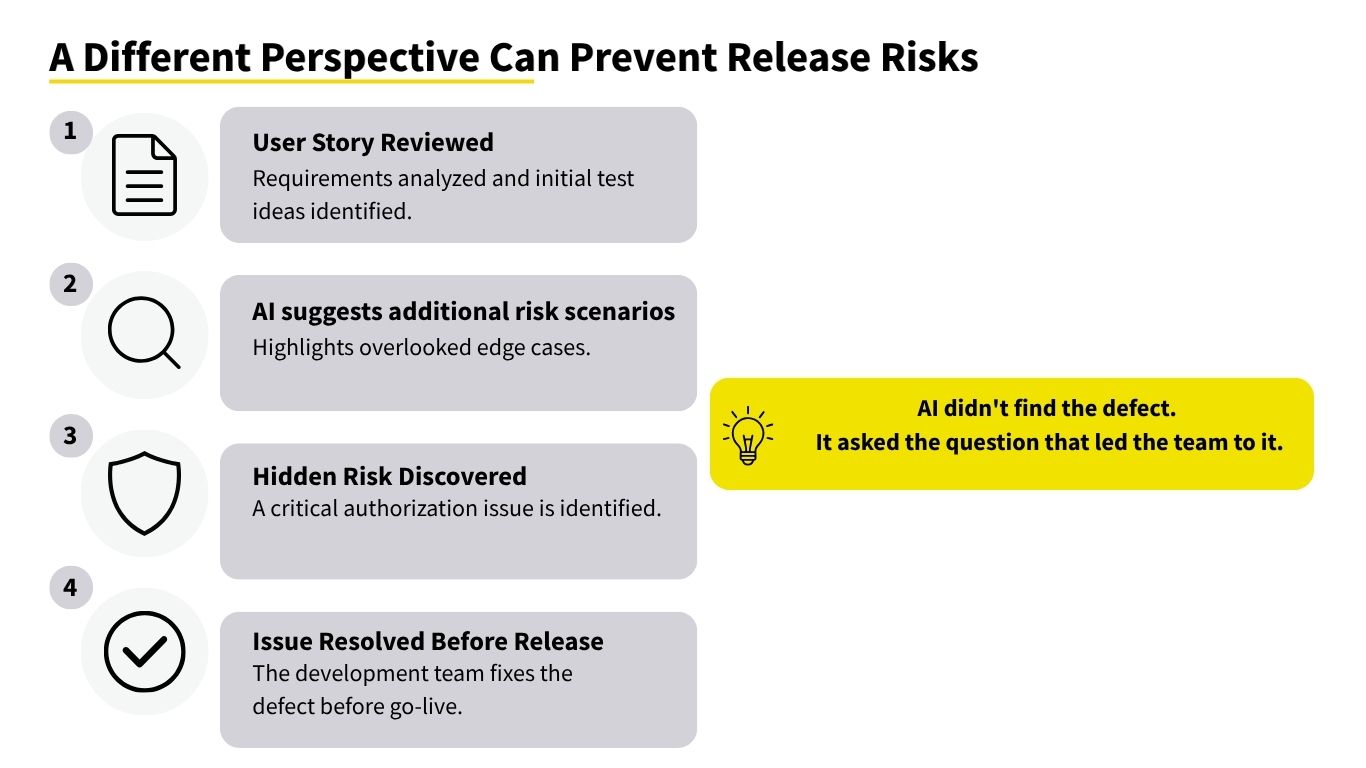
An experienced tester never simply reads a user story. Instead, they immediately start asking questions.
- What happens if the user enters invalid data?
- How does the system respond when permissions are missing?
- Have all boundary conditions been considered?
- Which edge cases might have been overlooked?
This way of thinking usually develops through years of project experience. AI cannot replace that experience. What it can do, however, is help surface these questions much faster.
When I analyze a user story with AI support, I receive initial test ideas, negative scenarios, and potential edge cases within seconds. Not every suggestion is useful, of course. But quite often, the most valuable insights are precisely those that would have been overlooked under the pressure of everyday project work.
A Real Project Example
In one of my projects, we were implementing a new user role management feature. The user story was well written and appeared complete at first glance.
Out of curiosity, I asked an AI assistant to analyze the requirements as well.
One of its suggestions was to explicitly test authorization scenarios that were not mentioned in the original story. More specifically, it highlighted situations where users might gain access to functionality that should not be available for their assigned role under certain conditions.
That single suggestion led us to uncover a defect. Under specific circumstances, users were able to access functions they should never have been allowed to use. The issue was identified before the release and corrected by the development team.
Was this proof that AI creates better testers?
No.
The real lesson was something entirely different. AI introduced an additional perspective into the analysis. It asked a question that nobody on the project team had considered before.
That is exactly where I see its greatest value.
My Biggest Takeaway
For me, AI's real value rarely lies in automatically generating test cases. What matters far more are the ideas it introduces during requirements analysis. It often highlights risks or challenges assumptions that everyone on the team had accepted without question. As a result, AI doesn't just improve the quality of individual tests—it often improves the quality of the requirements themselves.
AI as a Sparring Partner for the Entire Team
Not every organization has a large Quality Assurance department with dedicated Test Managers, Test Analysts, and automation specialists.
In smaller teams, Quality Assurance usually has to coexist with many other responsibilities. Developers write and test their own features. Product Owners perform business acceptance testing. And structured test analysis is often one of the first activities to disappear when projects become busy.
The challenge is that every role approaches software from a different perspective. Developers naturally focus on whether a feature has been implemented correctly. Business stakeholders verify whether their requirements have been fulfilled. Experienced testers take a different approach. They actively search for risks, unusual usage scenarios, and failure patterns that are not immediately obvious.
This is exactly where I use AI today as a sparring partner.
It suggests suitable testing approaches, highlights common weaknesses, and helps me challenge requirements in a more structured way. It certainly does not replace years of project experience, but it broadens the team's perspective and makes it far less likely that important questions will be overlooked.
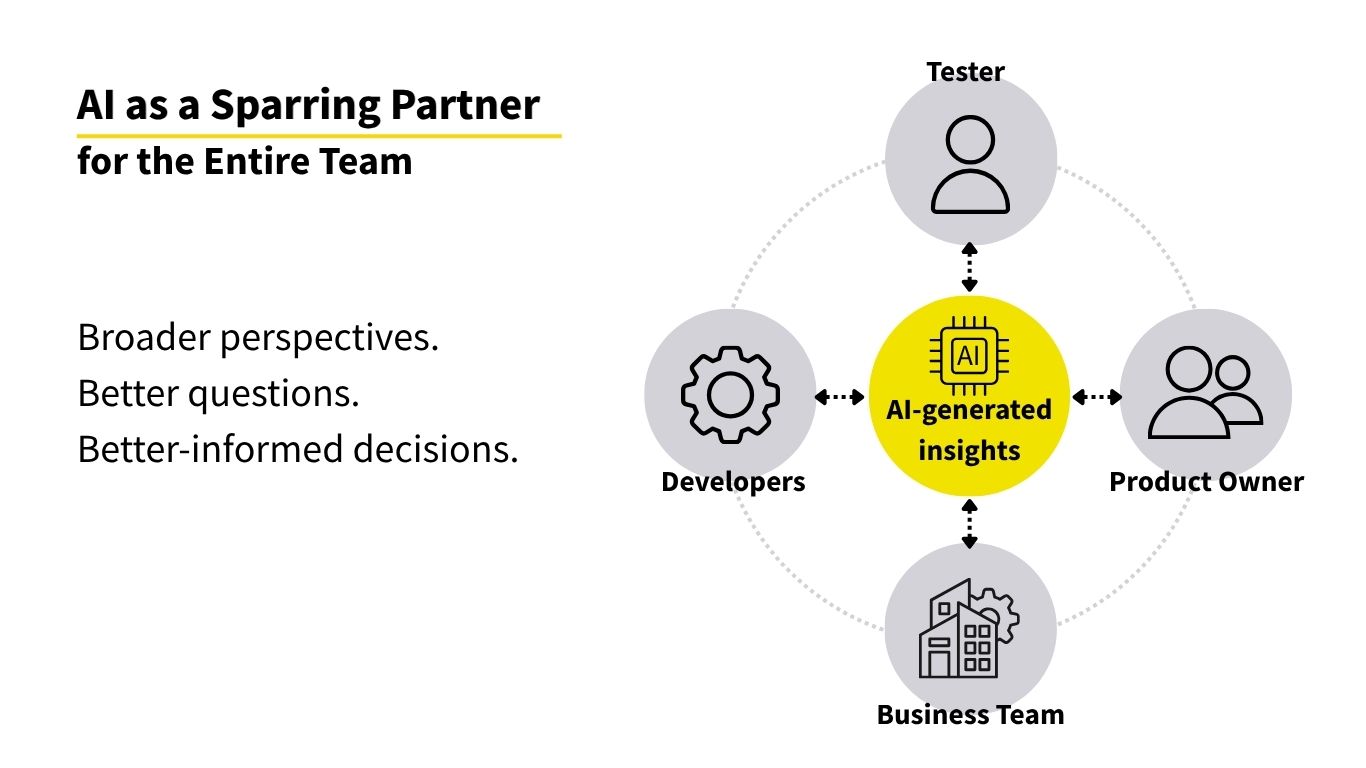
In my experience, this approach is especially valuable when onboarding new team members. Product knowledge can usually be transferred fairly quickly. Developing an instinct for risk takes much longer. New team members need to learn which questions to ask, which defects tend to recur in similar projects, and which areas deserve a second look.
AI can significantly accelerate this learning process. It does not replace an experienced mentor, but it helps newcomers develop an understanding of common risks and effective testing strategies much earlier.
Why Small QA Teams Benefit Most from AI
One statement comes up repeatedly in conversations with customers:"AI only makes sense for large enterprises."
My project experience tells a very different story.
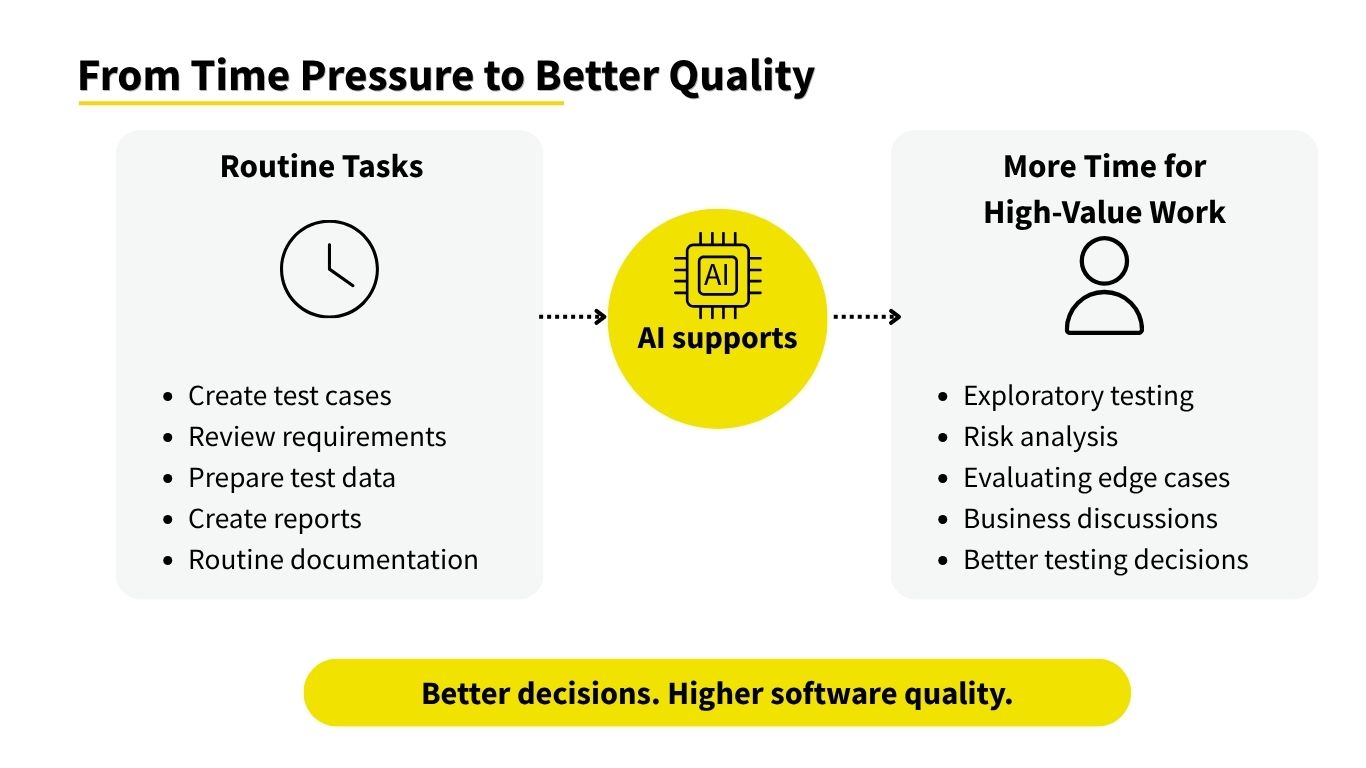
In fact, smaller QA teams often benefit the most—not because they use more advanced technology, but because they have fewer resources, fewer specialized roles, and far less spare capacity. Every hour saved on repetitive routine work can immediately be invested in activities that genuinely improve software quality.
In small teams, a single person often performs several roles at once. Test Managers coordinate releases, analyze requirements, design test cases, support business acceptance testing, and contribute to test automation—all while responding to last-minute requirement changes and constantly shifting priorities – or through external extensive packages for professional quality assurance when internal capacity is lacking.
Under these conditions, bottlenecks are inevitable.
AI does not eliminate those bottlenecks. What it does is dramatically reduce the time required for many preparatory activities. Requirements can be structured more efficiently. Initial test ideas appear within seconds. Known failure patterns can be considered much earlier. This gives the team more time to focus on the risks that actually matter.
To me, that is the key difference. Software quality does not improve because teams write more test cases. It improves because they spend their limited time where human expertise delivers the greatest value.
A Real Project Example
I have seen this several times with colleagues who had little or no previous testing experience. Using AI, they approached new tasks far more systematically.
Using AI, they approached new tasks far more systematically. It clarified unfamiliar terminology, suggested suitable testing techniques, and encouraged them to challenge requirements more critically. As a result, the onboarding process became noticeably faster. AI did not replace the learning curve. It simply allowed that learning curve to begin much earlier. In addition, training courses such as aqua’s aqua Intelligence: Generate Requirements, Test Cases, and Test Data with AI can further deepen practical skills.
AI Makes Test Automation More Accessible
Another area where I have come to appreciate AI over the past few years is test automation.
Most teams understand the long-term benefits of automated testing. It reduces repetitive work, improves regression coverage, and increases confidence in every release. Yet in many projects, introducing test automation is repeatedly postponed.
The reason is rarely a lack of awareness. Much more often, teams simply do not have enough time to learn a new framework or build their first automation scripts. I've seen this pattern in project after project. Once that opportunity is missed, the gap keeps growing. Every sprint introduces new functionality that has to be tested manually, making automation feel increasingly difficult to introduce.
This is another area where AI has become a valuable sparring partner. It explains automation frameworks, helps build initial test scripts, suggests appropriate assertions, and makes it easier to understand error messages. For colleagues with little or no experience in test automation, this often leads to meaningful progress much sooner than expected. That does not automatically result in good test automation.
A script can be technically correct and still add very little value. The real question is not how to automate a test, but which tests should be automated and why. Answering that question still requires project experience, business knowledge, and a clear understanding of project risks.
That is why I see AI not as a replacement for automation expertise, but as a tool that lowers the barrier to entry and accelerates routine work.
Where AI Has Clear Limitations
The more frequently I use AI in real projects, the more obvious its limitations become. It does not understand the business context of a project. It does not know which regulatory requirements are business-critical. It has no awareness of organizational constraints or internal politics. And it certainly cannot decide which risks a company is willing to accept.
That is why I evaluate every AI-generated suggestion just as critically as I would evaluate an idea from a new team member. Some suggestions are excellent. Others simply do not fit the project. And some sound convincing while being based on assumptions that do not apply to our situation at all.
This human judgment is what separates an interesting idea from a sound testing decision. That is why I still do not see AI as a decision-maker. I see it as a sparring partner—one that continuously introduces new perspectives. And in my experience, that is exactly where its greatest strength lies.
A Real Project Observation
Time and again, I have found that the best results come from combining the strengths of AI with the experience of skilled testers. AI brings speed, pattern recognition, and fresh perspectives. People contribute project knowledge, business expertise, and professional judgment. Only this combination leads to Quality Assurance that is both efficient and reliable.
How to Introduce AI into Your QA Team
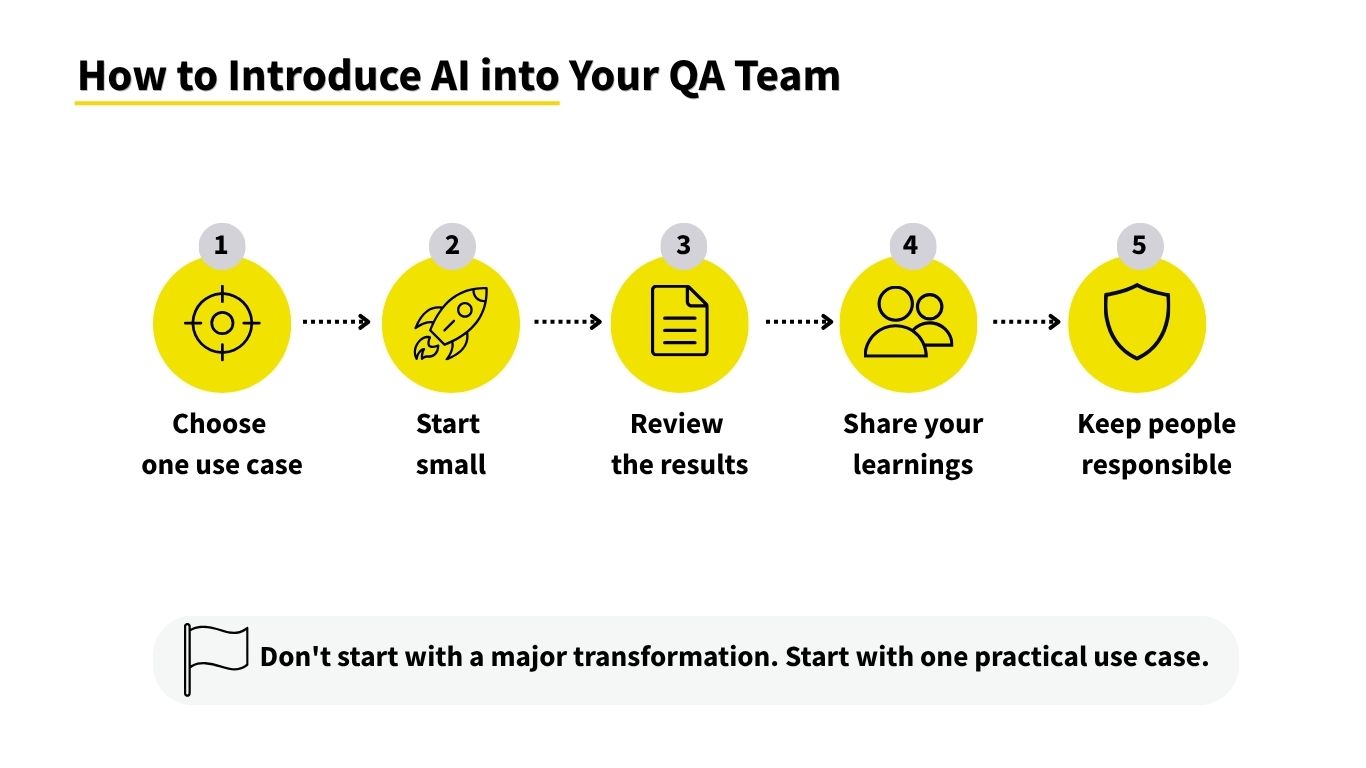
After using AI across a wide range of projects, I am often asked the same question:"Where should we start?" My answer has never changed. Don't start with a large-scale transformation program.
The best approach is to begin with one clearly defined use case. Analyzing user stories, brainstorming initial test ideas, or creating first test cases are all excellent starting points. This allows teams to integrate AI into their daily work without taking unnecessary risks.
Equally important is having realistic expectations. AI generates suggestions—not finished solutions. Every output should still be reviewed by someone who understands the project and its business context.
In my experience, the real value of AI grows gradually. Every successful use case builds confidence and helps teams identify where AI can genuinely strengthen their Quality Assurance process.
AI Does Not Replace Responsibility
The more I rely on AI, the more obvious its most important limitation becomes.
It provides answers.
It does not take responsibility.
AI can misinterpret requirements, overlook critical edge cases, or generate code that works technically while still failing to meet a project's quality expectations.
That is why every AI-generated suggestion deserves the same level of critical review as an idea proposed by a new colleague. Not because AI cannot be trusted, but because software quality always depends on the specific context of a project.
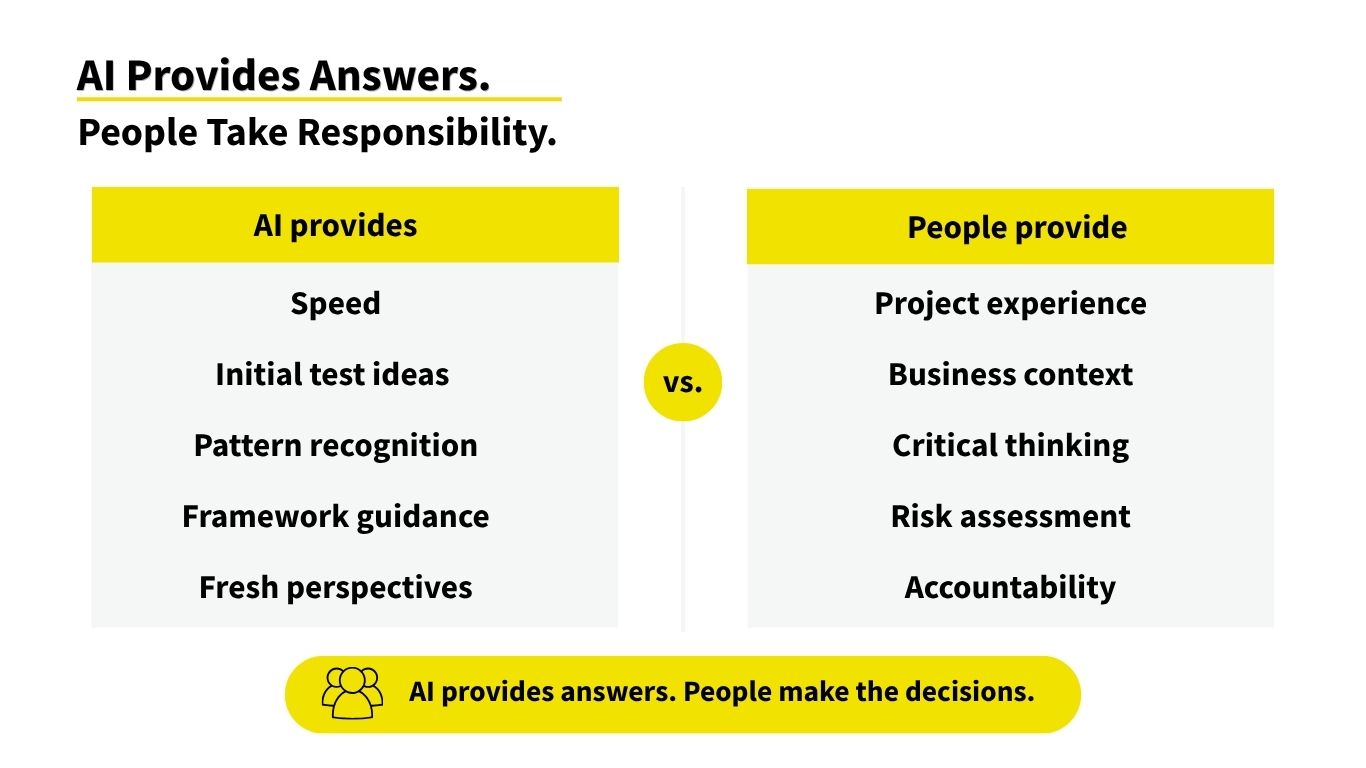
Experienced QA professionals bring capabilities that simply cannot be automated. They recognize contradictions between requirements, assess risks based on years of project experience, and ask the uncomfortable questions that often determine whether a release succeeds or fails.
AI can support that process. It cannot replace it.
A Real Project Observation
The most successful projects I have worked on were never the ones using the largest number of tools.
They were successful because the teams knew how to integrate new tools into their way of working without giving up responsibility or critical thinking.
That is exactly how I see AI in Quality Assurance today.
More Time for What Actually Improves Quality
Looking back at the projects I've worked on over the years, I no longer see speed as AI's greatest advantage.
Of course, requirements can be analyzed more quickly. Initial test ideas are generated within seconds. Documentation becomes easier to structure, and repetitive tasks can be automated. All of this saves valuable time.
But the real question is how that time is used.
Effective Quality Assurance is about far more than executing test cases or ticking boxes in a test management tool. Experienced testers challenge requirements, discuss risks with Product Owners and developers, and deliberately think about scenarios that are never described in a user story. Those conversations often determine whether a critical defect is found before release—or by the customer.
Today, AI can significantly accelerate many routine activities. That creates more room for exploratory testing, meaningful technical discussions, and analyzing complex business processes. These are kinds of work where experience, creativity, and critical thinking make the greatest impact. To me, that is where modern AI delivers its true value in Quality Assurance.
Conclusion: AI Doesn't Automatically Improve Quality Assurance. It Makes Good Teams More Productive
I am convinced that Artificial Intelligence will not replace software testers in the years ahead.
What it is already changing, however, is the way we approach Quality Assurance.
Smaller QA teams, in particular, stand to benefit because they often operate under constant time pressure and with limited resources. When routine work takes less time, teams can focus on the activities that have the greatest impact on software quality: analyzing requirements, assessing risks, communicating effectively, and making well-informed decisions.
That is why I do not see AI as a replacement for good Quality Assurance.
I see it as exactly that: a tool.
One that helps experienced teams become more productive, broaden their perspective, and ask better questions earlier in the process.
Because in the end, software quality is not created by algorithms.
It is created by people who make the right decisions.
Wondering where AI could add value to your QA team?
Our Quality Assurance experts can help you evaluate your current testing processes, identify practical AI use cases, and determine where intelligent automation can deliver measurable value without compromising quality or control.

